In-Play Horse Racing Strategy: Reading Live Odds and Timing Your Bets
 Available in US
Table of Contents
- Why In-Play Horse Racing Demands a Strategy, Not Just a Hunch
- How Live Odds Move During a Race
- The Back-to-Lay Setup in an In-Play Context
- Scalping Short-Priced Runners In-Play
- Cash Out vs Manual Trade: When to Close a Position
- Swing Trading Over Longer Races
- Staking Plans and Downside Control for In-Play
- Five Mistakes That Drain In-Play Bankrolls
- In-Play Strategy Questions Answered
Why In-Play Horse Racing Demands a Strategy, Not Just a Hunch
I still remember the moment it clicked. Haydock Park, a Saturday afternoon in 2019, and I’d just watched a 5/1 shot collapse to 14/1 in the space of forty seconds because it stumbled leaving the back straight. The punter next to me in the stand swore and ripped up his slip. I’d laid the same horse at 5.8 on the exchange ten seconds after the off. That single race taught me more about in-play horse racing than a year of pre-race form study ever did.
In-play betting on horse racing is not a faster version of pre-race betting. It is an entirely different discipline — one that rewards reaction speed, pattern recognition, and emotional control in roughly equal measure. The total turnover on British horse racing was down 4.2% by the end of Q3 2025 compared with the year before, and a full 12.8% below 2023 levels. The market is thinning. Casual money is leaving. What remains is sharper, more informed, and less forgiving of sloppy execution.
That shift is exactly why having a structured approach matters more now than at any point in the past decade. The days of lobbing a tenner at a live favourite and hoping for the best are not gone — plenty of people still do it — but the edge available to punters who treat in-play as a strategic exercise has widened precisely because the average quality of opposition has improved. This guide is built around the methods I use every racing day. No theory for its own sake, no textbook padding. Every section connects to a decision you will face during a race.
Whether you are already comfortable with live betting on horse racing and want to sharpen your timing, or you have been watching in-play markets and want a framework for entering them, the structure here moves from how prices behave in real time, through specific setups like back-to-lay and scalping, to the staking discipline that stops one bad afternoon from wiping out a month of gains.
How Live Odds Move During a Race
Picture a six-runner novice hurdle at Exeter. The favourite is 2/1 pre-race. The tape goes up. Nothing dramatic happens in the first half-mile — the field is bunched, jumping adequately, no mistakes. On the exchange the favourite’s price barely flickers, drifting from 3.0 to 3.1. Then, coming to the third flight, the favourite pecks on landing, loses half a length. Within two seconds the price is 3.6. Two fences later it travels smoothly into second and the price drops back to 2.8. That entire arc — from 3.0 to 3.6 to 2.8 — happened in under ninety seconds of racing.
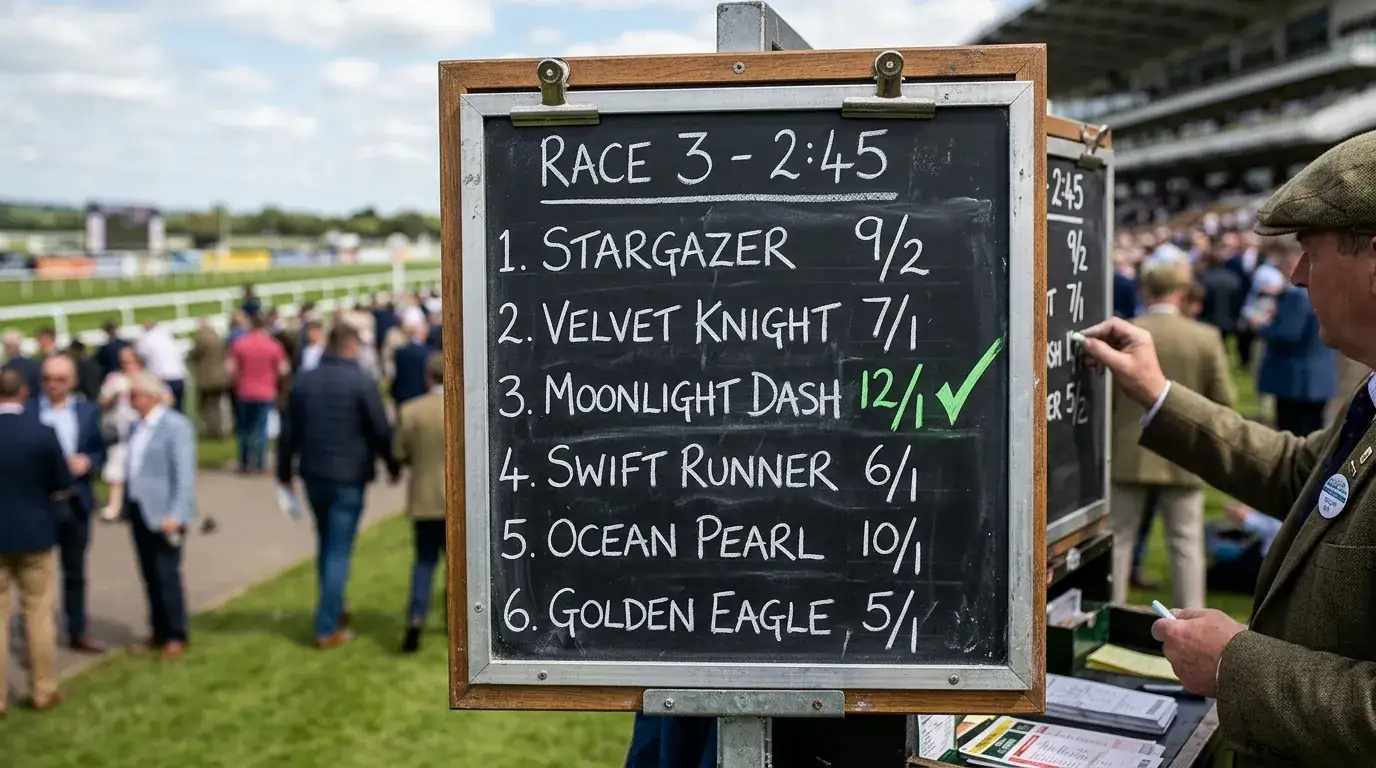
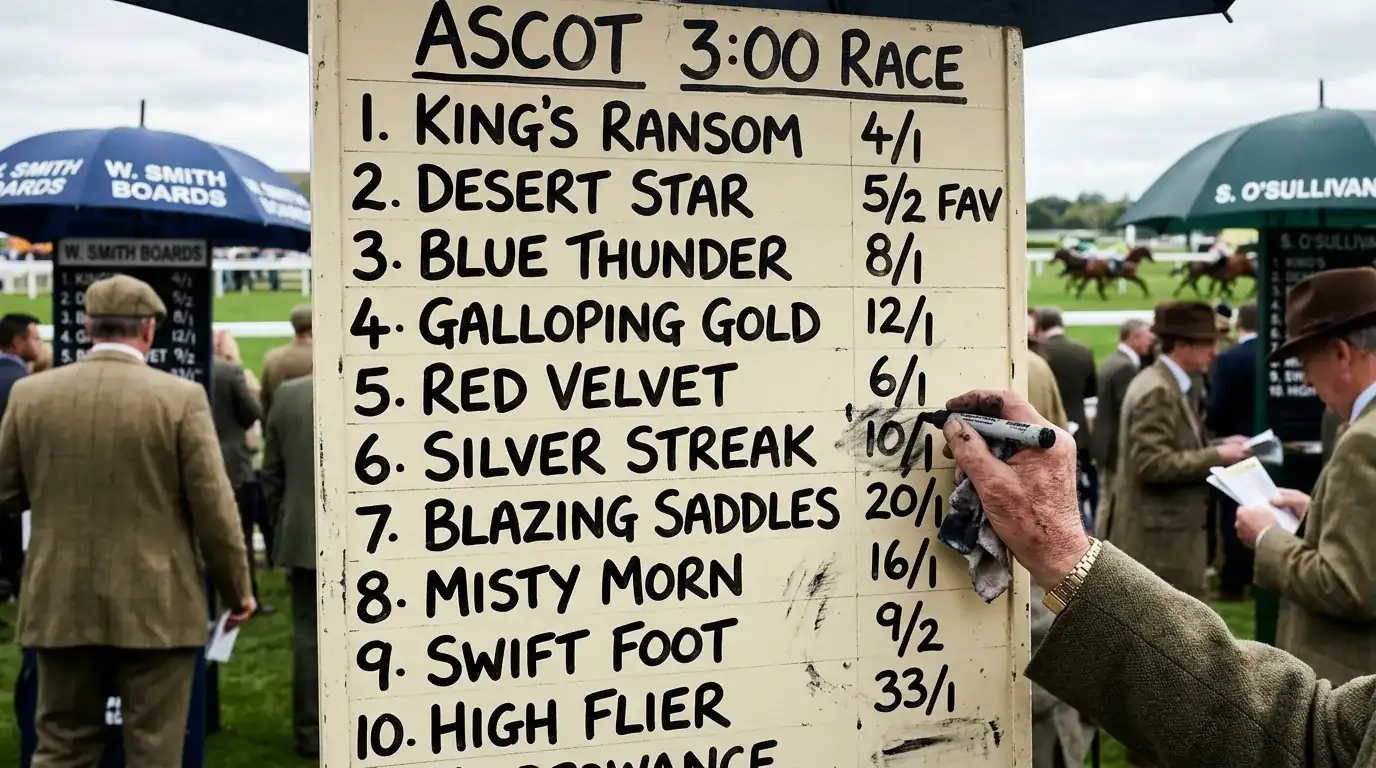
In-play odds in horse racing are a real-time consensus. They reflect what every participant in the market believes about a horse’s winning chance at that exact moment, weighted by how much money they are willing to stake on that belief. The mechanics are straightforward: when more money backs a horse, the price shortens; when more money opposes it (or backs its rivals), the price drifts. What makes horse racing unique is the speed and amplitude of these movements. A horse can go from 4.0 to 20.0 in the time it takes to fall at one fence, or from 6.0 to 1.5 when it hits the front turning for home.
Three forces drive in-play price movement. The first is positional information — where the horse sits in the field, whether it is travelling well or being pushed along, how close it is to the leaders. The second is incident — a stumble, a refusal, interference, or a jockey dropping the whip. The third, and the one most punters underestimate, is herd psychology: when a price starts moving, other participants pile in because the movement itself becomes the signal. That third force is what creates overreactions, and overreactions are where profit lives.
Favourites win roughly 34% of all races in the UK. That number has been stable for years. It means that two-thirds of the time the market leader does not win — but in-play, the favourite’s price will often contract sharply every time it moves into a prominent position, regardless of whether that move is sustainable. Learning to distinguish between a genuine move and a positional illusion is the single most important skill in live horse racing markets.
The practical takeaway is this: do not treat in-play odds as a mirror of reality. They are a lagging, emotion-amplified version of reality. Your edge comes from knowing when the price has overshot the actual change in probability — and acting on that gap before the market corrects itself.
Pre-Race Drift and Its In-Play Implications
A horse that drifts from 3.0 to 5.0 in the final ten minutes before the off is telling you something. The market is losing confidence. Maybe the ground has changed and it does not suit. Maybe a whisper about it not being off has filtered through. Maybe a well-informed stable connection has laid it. Whatever the reason, that pre-race drift does not evaporate the moment the race starts — it carries forward into the in-play market.
I track pre-race drifters specifically because they create asymmetric in-play opportunities. A horse that has drifted from 3.0 to 5.0 and then jumps well and sits handy at the first fence will see its in-play price contract sharply — not because it has done anything exceptional, but because the market had priced in the drift’s negative sentiment. The correction can be worth two or three ticks on the exchange, which for a scalper is a full trade.
Conversely, a horse that has been heavily backed pre-race — steaming from 6.0 to 3.5 — enters the in-play market with inflated expectations. If it does not immediately travel prominently, the price drifts faster than it would for a horse that started at 6.0 and remained there. The steamer has further to fall because the in-play market partially relies on pre-race momentum as a confidence anchor.
My approach: flag any horse whose pre-race price has moved more than 25% in either direction in the final fifteen minutes. Then watch that horse’s first thirty seconds of racing. The gap between pre-race sentiment and early in-play evidence is where the most reliable short-term setups appear.
The Back-to-Lay Setup in an In-Play Context
Back-to-lay is probably the most discussed strategy in exchange trading circles, but most explanations focus on the pre-race version — back a horse early, wait for it to shorten, lay it off for a guaranteed profit. The in-play version is a different animal entirely, and in many ways it is more intuitive once you understand how races unfold.
Here is the setup. You identify a horse that you believe is likely to trade at a shorter price at some point during the race than the price available right now. You back it. When the price shortens, you lay it. The difference between your back price and your lay price, multiplied by your stake and adjusted for commission, is your profit — regardless of whether the horse wins.
In an in-play context, the back entry usually comes at one of two moments: either immediately after a negative incident that you judge to be less significant than the market’s reaction suggests (a stumble that the horse recovers from cleanly, a wide run into a bend that the jockey corrects), or during a quiet phase of the race when the price is drifting on low volume simply because no new information is entering the market. The lay exit comes when the horse reasserts itself — moving into contention, jumping cleanly, or benefiting from a rival’s mistake.
The critical difference between pre-race and in-play back-to-lay is time compression. Pre-race, you might hold a position for twenty minutes. In-play, the whole trade can last fifteen seconds. That compression means your decision-making has to be pre-loaded: you need to know before the race starts which horses you are watching, what prices you would back at, and what events would trigger your entry. If you are making these decisions for the first time while the race is running, you are already too slow.
For a deeper dive into how exchanges handle back and lay mechanics, the dedicated piece covers liquidity, matching, and commission in full. Here, the focus stays on the tactical in-play application.
Choosing Races for Back-to-Lay
Not every race suits a back-to-lay approach. Nine years of doing this have taught me that the setup works best when three conditions align: the race has enough distance for multiple price swings to develop, the field is small enough that liquidity concentrates on the key runners, and the race type creates natural moments of drama (fences to jump, hills to climb, pace to burn).
The BHA’s own data shows that average turnover on Premier Fixtures grew 2.7% even while Core Fixtures dropped 8.6%. That divergence matters for in-play traders because Premier meetings deliver the liquidity you need to get matched at the prices you want. A Saturday Grade 1 novice chase at Sandown will have ten to twenty times the in-play liquidity of a Tuesday selling hurdle at Plumpton. Liquidity dictates whether your back-to-lay trade executes at your target price or sits unmatched while the market moves past you.
National Hunt races over two and a half miles or longer are my preferred hunting ground. The distance gives the race structure — early pace, a middle quiet phase, and a build to the finish. Each transition creates a price movement. Flat sprints, by contrast, are over too quickly for most in-play trades to settle; by the time you have identified an opportunity and submitted your order, the race is in its final furlong.
I generally avoid maiden hurdles with large fields of unexposed horses. The form is unreliable, the running style of each horse is unknown, and the in-play price movements are erratic rather than patterned. The best back-to-lay races feature horses with established running styles — front-runners, hold-up horses, strong travellers — because their behaviour during the race is more predictable, which makes price movements more readable.
Scalping Short-Priced Runners In-Play
Scalping is the most misunderstood strategy in in-play horse racing. People hear the word and picture high-frequency trading — lightning-fast entries and exits, algorithmic precision, impossible for a human to replicate. That is not what scalping looks like on a horse racing exchange. It is slower, chunkier, and entirely manual for most participants.
A scalp on a short-priced runner works like this. You have a horse trading at 2.4 in-play. It is travelling well, sitting third, jumping cleanly. You lay it at 2.4. Two fences later, it is still third, still travelling well, but the leader has kicked on and the gap has opened slightly. The market nudges the price to 2.5. You back at 2.5. The difference is one tick — about 4% of your liability — and after exchange commission you might net 3.5%. The entire trade lasted forty-five seconds.
Three and a half percent sounds trivial until you run the numbers over volume. Ten successful one-tick scalps at fifty pounds liability each produces seventeen pounds fifty in a session. Do that four days a week across a racing season and the annual figure is meaningful. The catch — and it is a significant one — is that scalps go wrong. A horse you have laid at 2.4 can win, costing you the full liability. One losing trade can wipe out ten winning scalps.
The skill in scalping is not the execution. It is the selection. You want horses whose prices are oscillating within a narrow band because the race situation is stable: the pace is even, positions are settled, no incidents are occurring. The moment the race enters a transition phase — the pace quickens, horses begin to challenge, obstacles arrive — the price band widens and the scalping window closes. Recognising that transition point, and closing your position before it arrives, separates profitable scalpers from those who hand back their gains in a single blown trade.
I limit my scalping to races where the favourite is trading between 1.8 and 3.5 in-play. Below 1.8, the tick size is too small to cover commission. Above 3.5, the volatility increases and the price oscillation becomes unpredictable enough that the risk-reward of a one-tick scalp deteriorates. Within that band, National Hunt races with steady early gallops and competent jumping provide the most consistent scalping windows — typically between the second-last and the home turn, before the race enters its decisive phase.
Cash Out vs Manual Trade: When to Close a Position
Last March, I had a back position on a 7/1 shot in a handicap hurdle at Cheltenham. Two flights from home it was travelling like the winner, my position was showing a projected profit of over two hundred pounds, and the bookmaker cash-out button was flashing green. I did not press it. I opened the exchange and laid manually at 2.2. The horse won. My manual lay locked in a slightly higher profit than the cash-out offer would have paid, because the bookmaker’s cash-out price included a margin I was not willing to concede.
That margin is the core of the cash-out debate. When a bookmaker offers you a cash-out figure, they are not offering you the fair value of your position. They are offering you the fair value minus their edge — typically between 3% and 8% depending on the operator, the market, and the timing. On a ten-pound position that is a few pence. On a hundred-pound position approaching the final fence, the gap between cash-out and manual trade can be ten to fifteen pounds.
Manual closing means placing the opposite bet yourself. If you backed at 8.0 and the horse is now trading at 2.5, you lay at 2.5 for the appropriate stake to equalise your position. The maths is straightforward: divide your original back stake by the current lay price, then multiply by the back price. The result is your lay stake for a fully hedged “green book” — profit regardless of outcome. Exchange commission applies, but at 2% to 5% of net winnings it is almost always cheaper than the bookmaker’s built-in cash-out margin.
There are situations where cash-out genuinely makes sense. If the exchange market is thin and you cannot get matched at the lay price you want, the bookmaker’s instant cash-out removes execution risk. If you are away from your screen and can only manage the bet through a mobile app without exchange access, cash-out is better than letting the position ride unmanaged. And if the cash-out figure is within 1% of your manual calculation, the convenience is worth the small cost. But as a default, manually closing positions on the exchange preserves more of your edge over time.
Swing Trading Over Longer Races
The Grand National is four miles and two furlongs. The Scottish Grand National is four miles and one furlong. The Welsh Grand National is three miles and five furlongs. These marathon chases are where swing trading comes into its own, because the sheer duration of the race creates multiple distinct phases — each with its own price structure, its own drama, and its own opportunities.
Swing trading differs from scalping in both ambition and holding period. Instead of hunting for one-tick oscillations within a stable price band, a swing trader backs a horse at a high point in its price arc and lays it at a low point — or vice versa. The price movement might be four, five, or six ticks rather than one. The holding period might be two minutes rather than forty seconds. The risk is proportionally larger, but so is the reward per trade.
Average turnover per race fell 5.8% in 2025 versus 2024. That reduction in overall market activity has a counterintuitive effect on swing trading: with less noise in the market, genuine price moves driven by race events become cleaner and more readable. Alan Delmonte of the Horserace Betting Levy Board noted that the early months of 2025 produced unusually high bookmaker gross margins, partly shaped by outcomes at the Cheltenham Festival that favoured the layers. For swing traders, high-margin periods often coincide with volatile in-play markets where front-runners collapse and closers arrive late — exactly the kind of drama that generates wide price arcs.
My swing-trading framework for long-distance chases is structured around three checkpoints. The first is the end of the first circuit (in a race with two circuits): by this point you know which horses are jumping well, which are struggling, and roughly where the pace is relative to what the form suggested. The second checkpoint is the approach to the home turn on the final circuit, where pace typically lifts and the pretenders fall away. The third is two fences from home, where the race resolves into its final shape. Each checkpoint is a potential entry or exit point. Between checkpoints, I let the position run unless something dramatic changes.
The worst mistake in swing trading is overtrading. Opening and closing positions at every fence turns a swing strategy into an undisciplined scalp with swing-sized risk. Set your checkpoints before the race, commit to them, and evaluate only at those moments. The rest of the time, watch the race — not the screen.
Staking Plans and Downside Control for In-Play
Every strategy in this guide — back-to-lay, scalping, swing trading — produces losing trades. That is not a flaw. It is arithmetic. The question is never whether you will lose, but whether your wins outweigh your losses over a sample large enough to smooth out variance. Staking discipline is what keeps you alive long enough to reach that sample.
For in-play trading, I use a fixed-liability model rather than a fixed-stake model. The difference matters. If I back a horse at 6.0 for ten pounds, my potential loss is ten pounds. If I lay a horse at 6.0 for ten pounds, my potential loss is fifty pounds. Fixed-stake thinking treats both positions as equivalent because the stake is the same. Fixed-liability thinking sizes positions so that the maximum loss on any single trade is a predetermined percentage of the trading bank — usually between 1% and 3%.
With a one-thousand-pound in-play trading bank and a 2% maximum liability per trade, no single losing trade costs more than twenty pounds. At that level, a run of ten consecutive losses — which happens more often than most people expect — draws down the bank by 18.3% (not 20%, because each successive loss is calculated on the reduced balance). Uncomfortable, but recoverable. At 5% per trade, the same losing run takes 40.1% of the bank. That is the kind of drawdown that breaks discipline and leads to revenge trading.
The second pillar of in-play risk control is session limits. I set a daily loss limit of 5% of the trading bank. If I hit it — which happens perhaps once a fortnight — I stop. Not for five minutes, not after the next race, immediately. The temptation to chase losses in-play is stronger than in any other form of betting because the next opportunity is always minutes away. That proximity is the trap. Session limits are the cage around the trap.
I also track every trade in a spreadsheet: entry price, exit price, stake, liability, outcome, race conditions, and a one-line note on why I entered the trade. The note is the most important column. After a hundred trades, patterns emerge. You discover that your scalps on heavy ground are significantly less profitable, or that your swing trades on right-handed tracks perform better. Without the data, those patterns stay invisible. With it, they become actionable adjustments.
Five Mistakes That Drain In-Play Bankrolls
Nine years of in-play trading, and I have made every one of these mistakes — most of them more than once. They are not exotic errors. They are obvious in hindsight and invisible in the moment, which is precisely what makes them dangerous.
Trading every race on the card. An eight-race card does not contain eight opportunities. On a good day, two or three races will present setups that match your criteria. The rest are noise. Trading them anyway because you are “already watching” is the fastest way to turn a profitable afternoon into a flat or losing one. Quality of setup beats quantity of activity, every single day.
Entering a trade without a defined exit. If you do not know the price at which you will close your position before you open it, you do not have a trade — you have a gamble. Define the exit before the entry. If the price reaches your target, close. If it does not, close at your stop-loss. No exceptions.
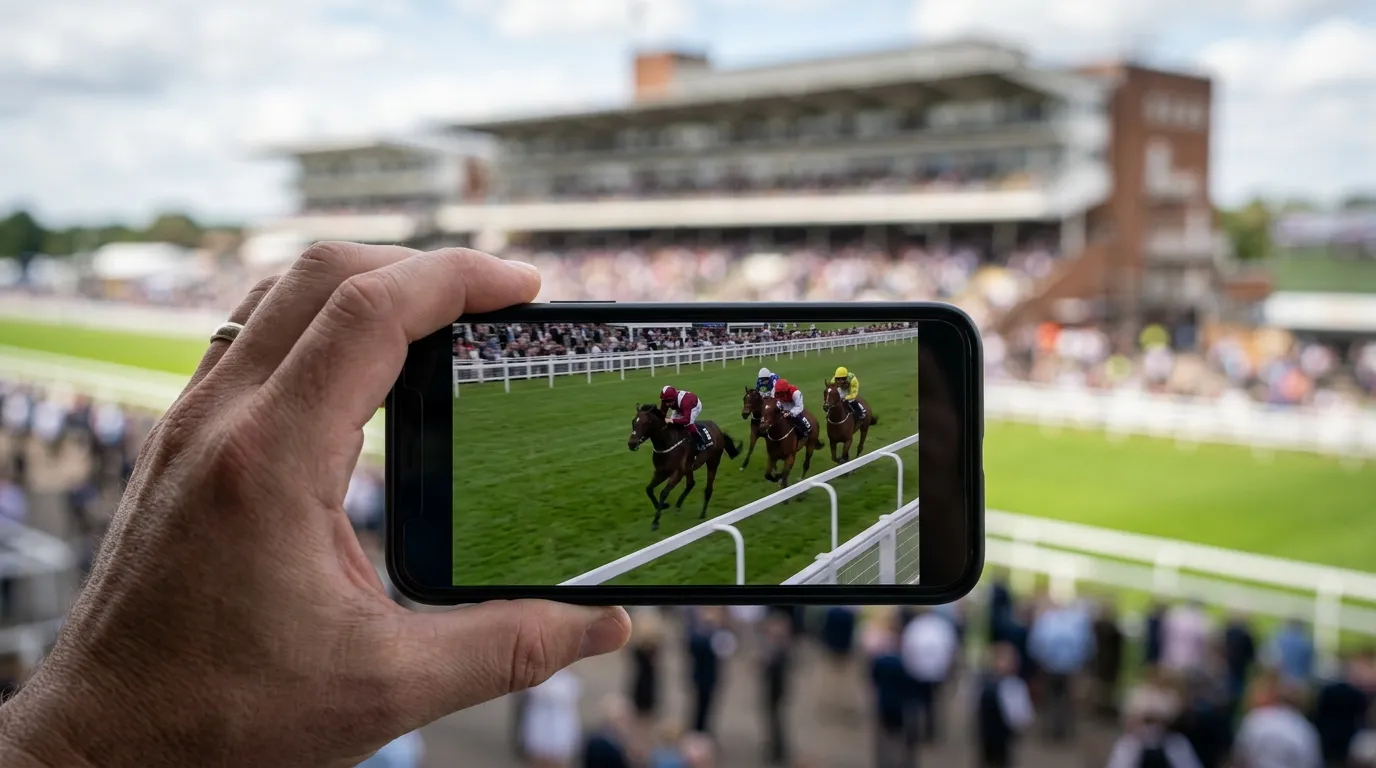
Ignoring the stream delay. The live video feed you watch on a bookmaker’s app or streaming service runs between one and four seconds behind real time. The exchange market, meanwhile, is being updated by participants who may have access to faster feeds or even course-side information. If you are reacting to what you see on your screen, you are trading on stale data. The implication is not that you cannot trade profitably with a delayed stream — you can — but that you must factor the delay into your execution. If you see a horse peck at a fence on your stream, the exchange price has already moved by the time you register it. Your entry price will be worse than the price that existed at the moment of the incident.
Doubling down after a loss. You laid a horse at 3.0, it won, and you lost sixty pounds. The next race features what looks like a perfect setup. The temptation to increase your stake to recover the loss is overwhelming — and almost always wrong. The setup either meets your standard criteria, in which case you trade it at your standard liability, or it does not, in which case you skip it. The outcome of the previous race has zero bearing on the probability of the next one.
Confusing activity with progress. Placing forty trades in a day and finishing five pounds up is not progress. It is treading water with maximum exposure to commission. Fewer trades at higher conviction, with larger average profit per trade, is a more sustainable path than high-frequency churning on marginal setups. If your hit rate is above 60% but your average profit per trade is below your commission cost, you are working for the exchange, not for yourself.
In-Play Strategy Questions Answered
What is the minimum bankroll needed to start back-to-lay trading on horse racing?
A practical starting point is 500 pounds dedicated to in-play trading. At 2% maximum liability per trade, that gives you 10 pounds of risk per position — enough to trade on the exchange without being forced into micro-stakes where commission erodes your edge. Below 300 pounds, the maths becomes difficult because your stake sizes are too small to generate meaningful returns after commission, and a normal losing run can push you below the minimum stake thresholds on most exchanges.
How does stream delay affect in-play horse racing strategies?
Live video feeds from bookmakers and streaming services run between one and four seconds behind real time. Exchange prices, however, react almost instantly because some participants have access to faster data sources. This means that if you trade based on what you see on screen, your entry price will already reflect the event you are reacting to. The practical adjustment is to factor the delay into your target prices — if you see a stumble on stream and the exchange price has moved two ticks, the opportunity may already be priced in. Some traders use audio commentary alongside video to shave a fraction off reaction time.
Is scalping profitable on short-priced horse racing favourites?
It can be, within a narrow price range. Scalping works best on horses trading between 1.8 and 3.5 in-play, where tick sizes are large enough to cover exchange commission and the price oscillates in a readable pattern during stable phases of a race. Below 1.8, the increments are too small. Above 3.5, volatility makes one-tick scalps unreliable. Profitability depends on discipline — exiting before the race enters a transition phase and accepting that a single blown trade can wipe out multiple successful scalps.
When should I use cash out versus manually closing an in-play trade?
Default to manually closing on the exchange, because bookmaker cash-out prices include a margin of 3% to 8% that reduces your profit. Manual closing means placing the opposite bet yourself at the current exchange price, which preserves more of your edge over time. Use bookmaker cash-out only when exchange liquidity is thin and you cannot get matched at your target price, when you are away from your main trading setup and can only manage the bet via a mobile app, or when the cash-out figure is within 1% of your manual calculation and convenience outweighs the small cost.
Created by the ”Live Betting Horse Racing” editorial team.