Matched Betting on Horse Racing: How UK Punters Turn Free Bets Into Profit
 Available in US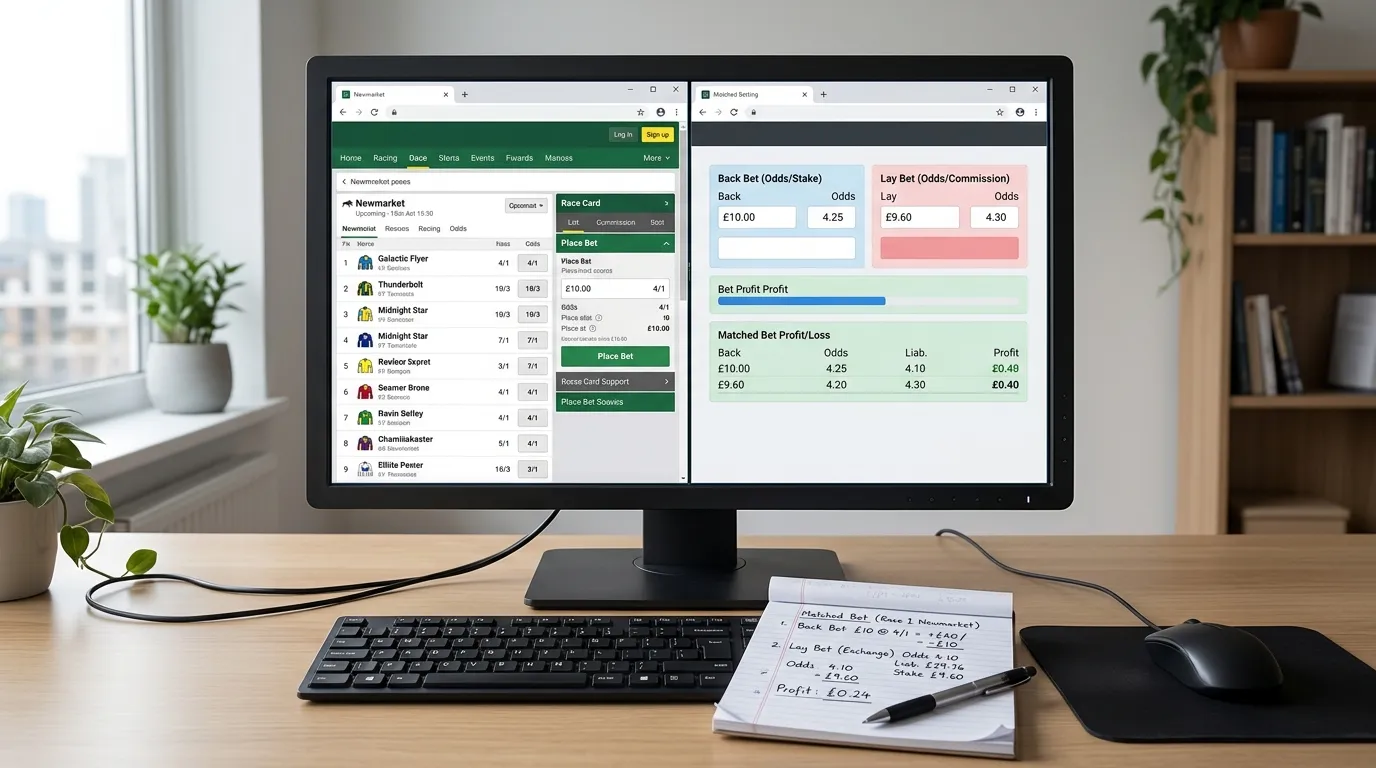
Matched Betting Removes the Gambling From Horse Racing Promotions
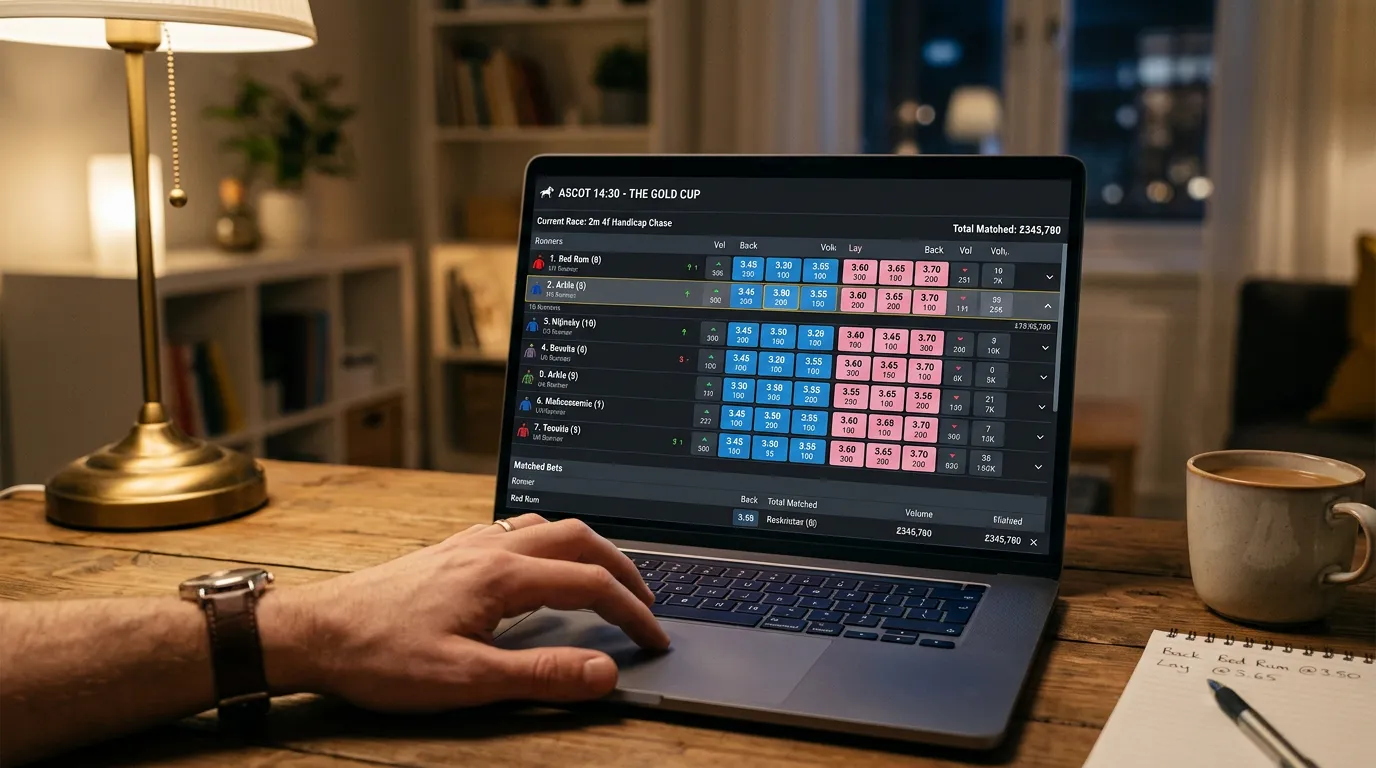
The first time I completed a matched bet on horse racing, I stared at my screen for five minutes checking the numbers. I’d placed a qualifying bet at a bookmaker, laid the same horse on an exchange, and after both bets settled, I’d lost 47p in commission — but I had a twenty pound free bet sitting in my account. Using that free bet on the next race and laying the same selection again, I extracted just over sixteen pounds in guaranteed profit. No risk, no gambling instinct involved, no emotional stake in the result. Remote horse racing betting generated 766.7 million pounds in GGY in the year ending March 2025, and a slice of the promotional spend behind that figure can be systematically harvested through matched betting.
Matched betting isn’t a grey area or a loophole — it’s an application of basic arbitrage principles to bookmaker promotions. The method works because bookmakers offer free bets and enhanced odds as customer acquisition tools, and exchanges provide the mechanism to neutralise the risk on the other side. Understanding how it works on horse racing specifically — where BOG, extra-place offers, and daily free bets create a richer promotional landscape than other sports — is worth every punter’s time.
How Matched Betting Works Step by Step on Horse Racing
The process has two phases: the qualifying bet and the free bet extraction.
In the qualifying phase, you place a bet at the bookmaker on a horse at the best available odds. Simultaneously, you lay the same horse on an exchange — betting against it at the closest possible odds. If the horse wins, the bookmaker pays out on your back bet, but you pay out on your lay bet. If the horse loses, you lose at the bookmaker but win on the exchange. The net result is a small loss, called the qualifying loss, which is the cost of “buying” the free bet. In horse racing, this qualifying loss is typically between two and five percent of the stake, depending on how closely the bookmaker and exchange odds align.
In the extraction phase, you use the free bet at the bookmaker on another horse — ideally at higher odds — and lay the same selection on the exchange. If the horse wins, the bookmaker pays out on the free bet (minus the original stake, since most free bets are “stake not returned”). If it loses, the exchange lay pays out. Either way, you lock in a profit that represents roughly 70-85% of the free bet’s face value, depending on odds and exchange commission.
Horse racing is particularly suited to matched betting because of the volume of daily races, the availability of BOG (which can add unexpected extra value to qualifying bets), and the generally good exchange liquidity on UK racing markets. Most mid-afternoon UK races have enough liquidity on the exchanges to match lay bets of twenty to fifty pounds without moving the price significantly.
Exploiting BOG and Price Differences for Risk-Free Returns
Best Odds Guaranteed creates a unique matched betting opportunity that doesn’t exist in football or other sports. When you place a qualifying bet with BOG active and the SP drifts above your fixed price, the bookmaker pays at SP — but your exchange lay was placed at the lower fixed odds. The difference is pure profit on top of the normal qualifying process.
This BOG bonus is unpredictable — you can’t control whether the SP will drift — but over hundreds of qualifying bets across a season, the cumulative BOG uplift is measurable. I tracked it over six months in 2024 and found that BOG added approximately three percent to my overall matched betting returns on racing. Flutter Entertainment, the parent company of several major operators, reported revenue of 15.91 billion dollars for 2025 — a 17% increase. The promotional budgets behind those revenues fund the free bets that matched bettors extract, and racing’s share of that promotional spend is substantial.
Extra-place promotions at festivals — where operators extend each-way terms to five or six places — create another matched betting angle. By placing an each-way bet at the bookmaker and laying both the win and the place on the exchange, you can isolate the extra places as pure profit if the horse finishes in the extended-place positions but outside the standard terms. This is more complex to execute and requires careful calculation, but the edge during festival weeks like Cheltenham, Aintree, and Royal Ascot is genuine.
Account Restrictions and the Lifespan of Matched Betting
Bookmakers are not oblivious to matched betting. They identify accounts that exclusively claim promotions, bet on exchange-friendly markets, and show patterns consistent with arbitrage. The consequence is account restriction — commonly called “gubbing” — where the bookmaker limits your maximum stake, removes access to promotions, or both.
Restrictions are inevitable for any serious matched bettor. The question is not whether they’ll happen but when, and how you manage the process to extend the profitable window. Placing occasional “mug bets” — bets on markets without promotional value, such as football or in-play racing, that make your account look like a recreational punter’s — can delay the inevitable. Varying your bet sizes, not always taking the maximum free bet value, and occasionally betting without laying all help to camouflage matched betting activity.
The realistic lifespan of a matched betting approach on horse racing is twelve to eighteen months across a portfolio of six to eight bookmaker accounts. Some accounts will last longer, some will be restricted within weeks. Once the major promotions are exhausted and the accounts are restricted, the returns diminish sharply. Matched betting is not a career — it’s a finite extraction process with a clear end point.
For punters who want to continue profiting from horse racing beyond matched betting, the transition to genuine value betting — identifying overlays through form analysis and market assessment — is the natural next step. The discipline of calculating expected value, managing stakes, and thinking probabilistically transfers directly. Matched betting teaches you to think like a trader; the challenge is applying those skills when the safety net of guaranteed profit is removed. For the mechanics of using exchanges as the foundation for that transition, understanding how back and lay works on UK exchanges is the essential prerequisite.
Matched Betting Questions Answered
Is matched betting on horse racing legal in the UK?
Yes. Matched betting is entirely legal. It involves placing bets with licensed bookmakers and using licensed exchanges, both regulated by the UKGC. No law prohibits exploiting promotional offers in this way. However, bookmakers reserve the right to restrict accounts that they believe are engaging exclusively in promotional exploitation, which is a commercial decision rather than a legal one.
How much can a UK punter realistically earn per month from matched betting on racing?
During the initial phase with unrestricted accounts, a dedicated matched bettor focusing on horse racing promotions can extract 300 to 800 pounds per month, depending on the number of active bookmaker accounts, the promotional calendar, and the festival schedule. Returns are highest during major racing festivals when extra-place and enhanced-odds offers peak. As accounts become restricted, monthly returns decline. The total lifetime extraction from a full set of bookmaker accounts is typically between 3,000 and 8,000 pounds.
Prepared by the Live Betting Horse Racing editorial staff.