Back-to-Lay Horse Racing: How Pre-Race Exchange Trading Works
 Available in US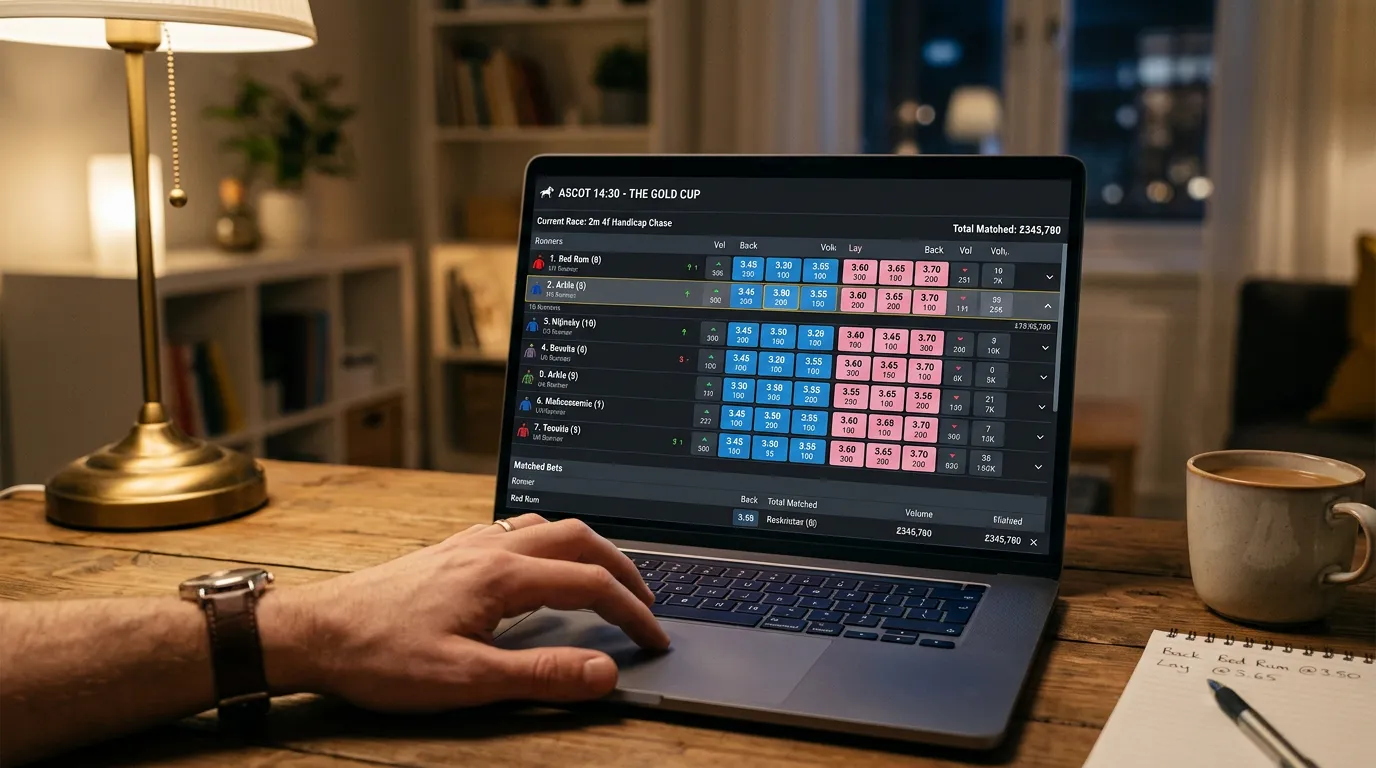
Back-to-Lay Is the Foundation of Horse Racing Exchange Trading
The first time I completed a back-to-lay trade on a horse race, I made eleven pounds before the race even started. I’d backed a horse at 8.0 on the exchange at 9:30 AM, watched the market contract through the morning as money came for the selection, and laid it at 5.5 an hour before post time. Green across the board — guaranteed profit regardless of the result. No analysis of form needed, no view on whether the horse would win. Just a read on which direction the price would move. Flutter Entertainment reported revenue of 15.91 billion dollars for 2025, and a significant slice of UK horse racing exchange activity consists of traders executing exactly this kind of pre-race position.
Back-to-lay is the simplest exchange trading strategy, and it’s the gateway through which most exchange traders enter the market. You back a horse at a higher price and lay it at a lower price, pocketing the difference. The concept is identical to buying low and selling high in any other market — the only difference is that you’re trading odds rather than shares.
How a Back-to-Lay Trade Works: A Worked Example
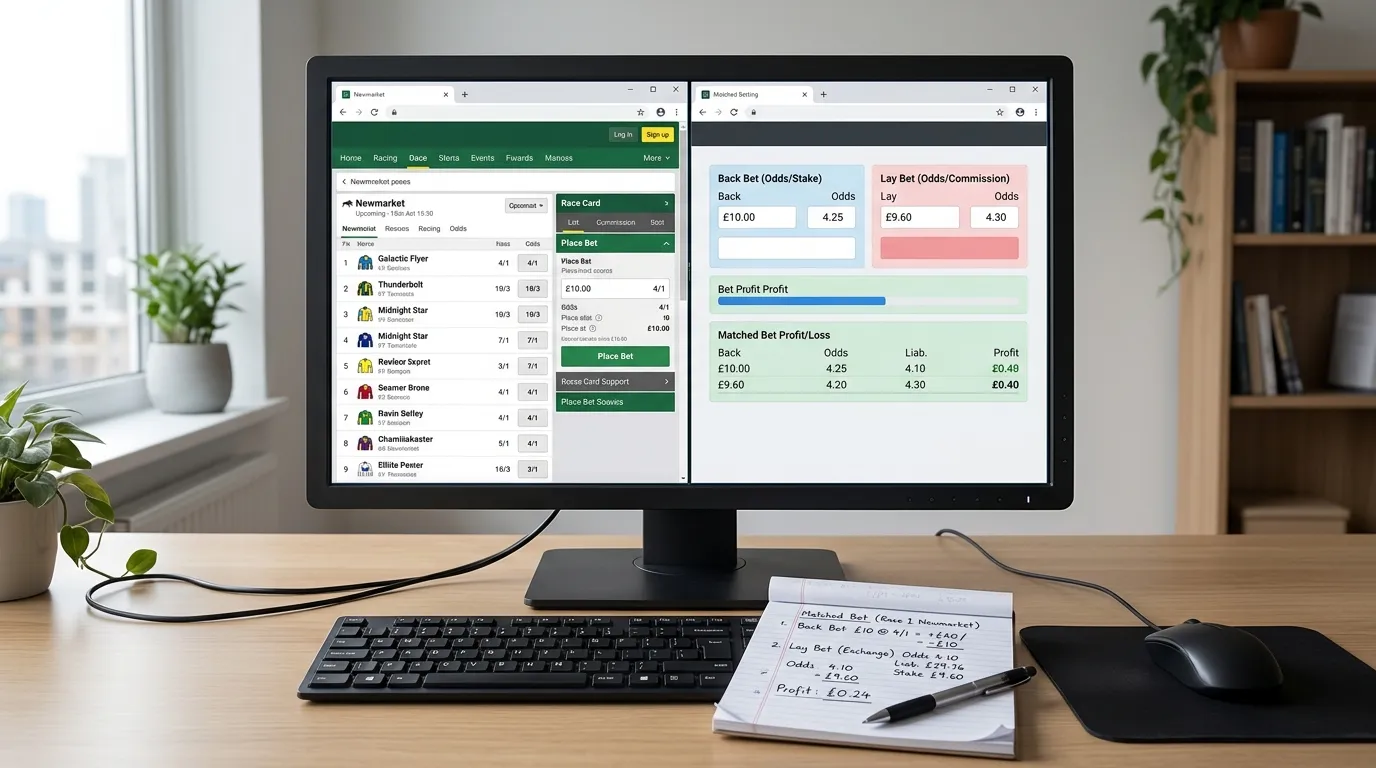
Let’s walk through the numbers. You identify a horse that’s trading at 10.0 on the exchange at 8:00 AM. You believe the price will shorten — perhaps because the horse has strong trial form that the market hasn’t fully absorbed, or because you expect informed money to arrive later in the morning. You place a twenty pound back bet at 10.0.
By midday, the market has moved. The horse is now trading at 6.0. You place a lay bet at 6.0. The question is: how much should you lay to guarantee profit regardless of the outcome? The formula balances the potential back winnings against the lay liability.
If you lay 33.33 pounds at 6.0, your position is: if the horse wins, your back bet returns 200 pounds (20 x 10.0), but your lay bet costs you 166.65 pounds (33.33 x 5.0 liability). Net profit: 13.35 pounds. If the horse loses, you lose your 20 pound back stake but win 33.33 pounds from the lay bet. Net profit: 13.33 pounds. Either way, you’ve locked in approximately 13.34 pounds profit before commission. That’s the essence of a back-to-lay trade — a guaranteed return regardless of the race result.
The profit comes from the gap between your back price and your lay price. The wider the gap, the bigger the profit. A back at 10.0 and a lay at 9.0 produces a much smaller green than a back at 10.0 and a lay at 6.0. The challenge is identifying horses whose prices will shorten significantly — and having the patience to wait for the move rather than panic-closing a position that hasn’t materialised yet. Win bets represent roughly 36% of all UK racing wagers, but exchange traders aren’t concerned with the result at all — they’re trading the price movement.
When to Back and When to Lay: Timing Signals
Timing is everything in back-to-lay trading, and the signals that predict price movement are more systematic than most people assume.
Early-morning prices on UK racing markets are set by the exchanges’ opening liquidity, which is thin. A horse might be available to back at 12.0 at 7:00 AM simply because there’s very little money in the market. As the morning progresses and professional traders, tipster followers, and informed punters enter the market, the price converges towards its “true” level. If the horse’s form merits a price closer to 8.0, the morning contraction from 12.0 to 8.0 is the window a back-to-lay trader exploits.
The strongest shortening signals include: a horse whose morning price is significantly longer than the tissue price published by industry compilers; a horse receiving a notable jockey booking confirmed overnight; a horse whose stable’s recent form has improved markedly; and a horse that drifted in its last race due to a specific factor (bad draw, wrong ground) that doesn’t apply today. Each of these creates a scenario where the current exchange price doesn’t reflect the horse’s actual probability, and the market’s correction is the profit source.
Conversely, the lay signal — indicating you should close your back position — is the stabilisation of price. When a horse’s exchange price stops contracting and begins to bounce or flatten, the shortening phase is over. Holding a position hoping for further contraction after the price has stabilised is how profitable trades become losing ones. I set a target exit price before entering any back-to-lay trade: if the horse is at 10.0 and I’m targeting 7.0, I lay at 7.0 or better. If it only reaches 8.0 and stalls, I take the smaller profit and move on.
Managing Liability and Greening Up
“Greening up” is the exchange term for distributing your profit evenly across all outcomes so that you make the same amount regardless of which horse wins. It’s the final step of a back-to-lay trade, and it’s what transforms an open position into a locked-in profit.
Most exchange platforms offer automated greening-up tools that calculate the correct lay stake for you. You click “green up” or “cash out” on your exchange position, and the platform places the closing lay bet at the current market price. The advantage is speed and accuracy — no mental arithmetic under pressure. The disadvantage is that the automated tool uses the current lay price, which might not be the best available. Manual greening up — calculating and placing the lay bet yourself — allows you to set a limit order at a price that’s slightly better than the current market, potentially increasing your profit if the price ticks one more point in your favour.
Liability management is the risk side of the equation. When you place a lay bet, you’re accepting liability equal to (lay stake x (lay odds – 1)). On a twenty pound lay at 6.0, your liability is a hundred pounds. That hundred pounds is held by the exchange as security until the bet is settled. If your bankroll is five hundred pounds, a single lay bet ties up twenty percent of your capital. Managing the number of open positions at any given time — never more than two or three simultaneous trades — prevents liquidity squeeze from paralysing your trading activity.
The discipline required for exchange trading is different from standard betting. There’s no emotional attachment to whether the horse wins or loses — the result is irrelevant once you’ve greened up. The emotional challenge is different: it’s the fear of missing a further price move, the frustration of a trade that doesn’t materialise, and the discipline to take small greens consistently rather than holding for a bigger move that might reverse. For the broader context of how exchanges operate and who benefits from them, the back-to-lay mechanic is the building block on which all exchange trading rests.
Back-to-Lay Questions Answered
What is greening up in horse racing exchange trading?
Greening up means placing a closing trade that locks in a guaranteed profit regardless of the race result. After backing a horse at a higher price, you lay it at a lower price, distributing the profit evenly across all outcomes. The term comes from the green figure displayed on the exchange platform when all outcomes show a positive return. Most exchange platforms offer automated greening-up tools that calculate and place the closing bet for you.
How much exchange liquidity do I need for a back-to-lay trade on UK racing?
For small-stake trading — back bets of ten to thirty pounds — most UK afternoon races have sufficient exchange liquidity from mid-morning onward. Feature races at major meetings and festival events have deep liquidity throughout the day. Early-morning and evening all-weather fixtures tend to have thinner markets. Check the matched volume and available liquidity on your target race before committing to a trade, and avoid markets where less than a few hundred pounds has been matched.
Prepared by the Live Betting Horse Racing editorial staff.