Horse Racing Betting Strategy: A Pre-Race Analysis Framework for UK Punters
 Available in US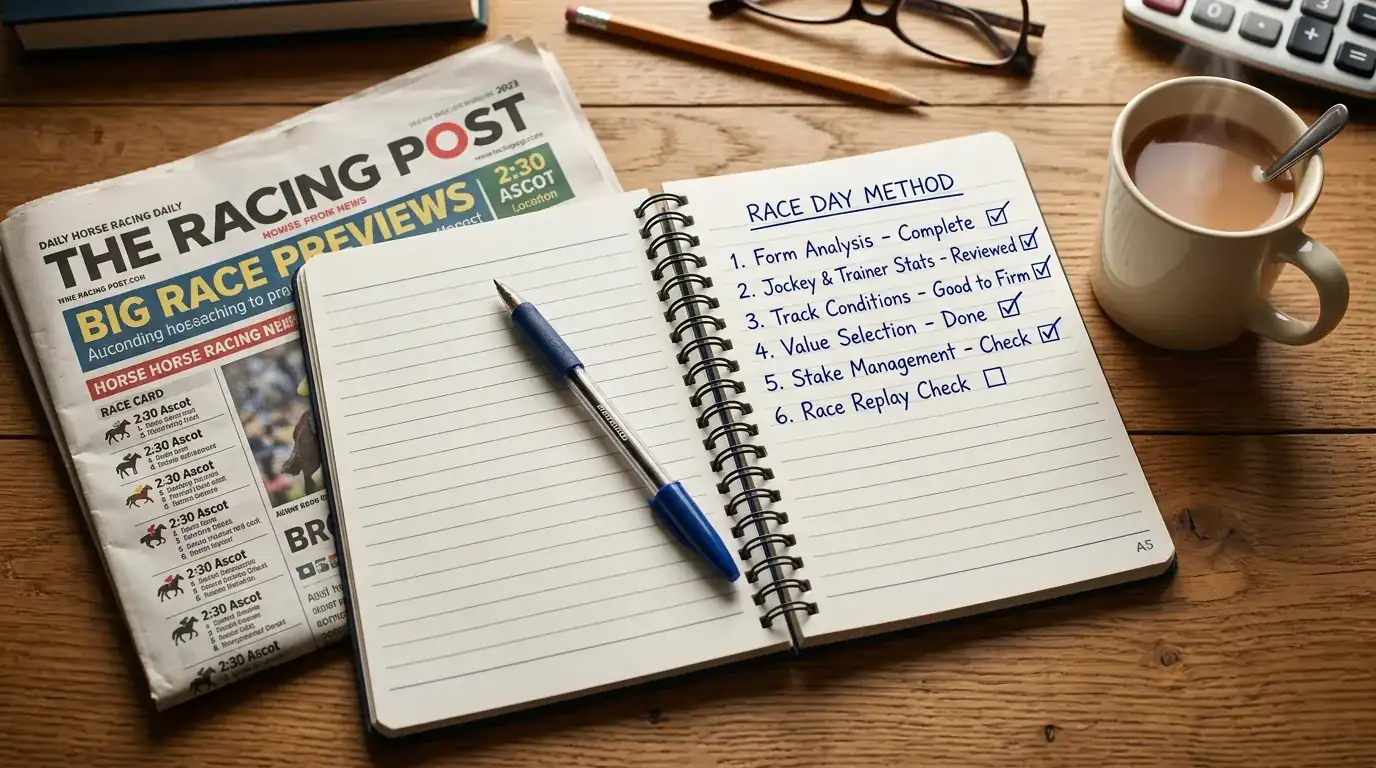
Strategy Separates Long-Term Profitable Punters From Everyone Else
Around 15% of UK adults place at least one horse racing bet each month. The overwhelming majority of them approach each race as a standalone event: scan the racecard, pick a name or a price, place the bet, watch the race, repeat. There’s no framework, no filtering process, and no systematic way to distinguish a bet worth making from one that isn’t. After nine years of analysing UK racing markets, I can tell you that the single biggest differentiator between punters who grind a profit and those who slowly bleed their bankroll is the presence — or absence — of a repeatable pre-race process.
Strategy isn’t intuition dressed up in analytical language. It’s a set of steps you follow before every race, applied consistently regardless of whether you’re having a good day or a bad one. What follows is the framework I use, stripped of complexity and built around the data that’s freely available for every UK race.
The Five-Step Pre-Race Analysis Framework
Step one: filter the card. Not every race deserves your attention. I start each day by scanning the full card — every meeting, every race — and eliminating those where I have no edge. Maiden races with unraced two-year-olds are essentially coin flips with no form to analyse. Seller-class races at minor midweek meetings produce unreliable form. Big-field handicaps where the ratings are compressed within three pounds are toss-ups. I typically reduce a 30-race Saturday card to six or seven races that merit detailed analysis. The rest I skip entirely.
Step two: assess the going. Before examining individual runners, I check the going report for every meeting I’m interested in. If the going doesn’t suit the profile of the races I’ve shortlisted — for example, if I’m looking at sprint races but the ground has turned heavy overnight — I remove those races from my list. Ground conditions are a pre-filter, not an afterthought.
Step three: form analysis. For each remaining race, I review the form of every runner, focusing on the four pillars: recent form figures, class level, distance suitability, and going preference. I’m looking for horses whose recent form is better than the market price implies — either because they’ve been running against stronger opposition, because they’re dropping in class, or because today’s conditions suit them better than their last outing’s conditions did. Favourites win about 34% of all UK races, and the goal of form analysis is to identify when that favourite is correctly priced and when it isn’t.
Step four: market assessment. Once I’ve identified my shortlist of selections from the form work, I check the current market. Is the price available better than the probability I’ve assessed? This is the value test. If I’ve estimated a horse’s win probability at 20% and the market is offering 6/1 (implied probability 14.3%), there’s an overlay worth exploiting. If the market is offering 3/1 (implied probability 25%), the horse is overpriced relative to my assessment and I pass. No overlay, no bet — regardless of how much I like the horse’s form.
Step five: stake and execute. Only bets that survive the first four steps reach the staking phase. The stake is determined by my bankroll management rules — typically 1.5% of bankroll for standard bets, 2% for strong selections. The bet is placed at the best available price across my accounts, and the record is logged immediately. No adjustments after the fact, no second-guessing mid-race.
Reading the Market Before the Off
The market is not an enemy — it’s a source of information. Price movements in the thirty minutes before a race carry genuine signal, and learning to read them is a skill that complements form analysis.
A horse that shortens from 6/1 to 4/1 in the final twenty minutes is attracting serious money from informed sources. That doesn’t guarantee it will win, but it tells you that people with access to information — yard connections, trial watchers, professional punters — believe its chance is better than the market was pricing. If your own form analysis already identified this horse as a selection, the market move is confirmation. If you hadn’t noticed it, the move is a prompt to take a closer look.
A horse that drifts from 5/1 to 8/1 is being abandoned by the market. Again, this is information, not prophecy. But a significant late drift on a previously well-supported horse often indicates that something has changed — the horse didn’t look right in the paddock, the ground has shifted against it, or inside information has cooled on its chance. I treat late drifters with extreme caution, even if my pre-race analysis was positive.
The market doesn’t know everything, but it knows more than any individual. Treating it as a collaborator rather than an opponent is the mindset shift that separates strategic punters from stubborn ones.
From Analysis to Execution: Placing the Bet
The best analysis in the world is worthless if the execution is sloppy. Taking a price two points below the best available, missing a BOG window, or placing a bet on a race you haven’t properly filtered — each of these execution errors erodes the edge your analysis created.
I use three accounts as my primary betting accounts for UK racing, selected for their BOG terms, odds quality, and in-play interface. Before placing any pre-race bet, I check all three for the best price on my selection. A one-point difference on a ten pound stake is ten pounds over a hundred bets. That compounding effect — tiny per bet, significant over a season — is the practical reason why odds comparison matters.
Timing matters too. For BOG-eligible bets, I place early in the morning to maximise the window for SP drift. For non-BOG bets where I expect the price to shorten, I place early to lock in the higher price. For bets where I expect the price to drift, I wait until closer to post time. This timing decision is the final strategic layer before execution, and it’s informed by the market-reading skills from step four of the framework.
The framework isn’t complicated. Five steps, applied consistently, with the discipline to skip races that don’t meet the criteria and the honesty to log results accurately. The difficulty isn’t understanding the process — it’s following it on a cold Tuesday in February when you haven’t had a winner in a week and the temptation to just pick something is overwhelming. That’s where bankroll discipline and the framework reinforce each other: the rules protect you from yourself.
Strategy Questions Answered
How many races per day should a systematic UK punter analyse?
Quality matters more than quantity. On a typical Saturday with thirty races across six meetings, a systematic approach might reduce the list to five to eight races worth detailed analysis, resulting in two to four actual bets. On quieter midweek cards, one or two bets — or none at all — is a normal outcome. Analysing every race is neither necessary nor productive; the goal is to identify the small number of races where your edge is greatest.
What is the minimum sample size to judge if a horse racing strategy works?
A minimum of two hundred bets is needed to begin distinguishing skill from variance, and five hundred bets provides a more reliable picture. Below two hundred bets, a positive or negative ROI could easily be explained by luck alone. At five hundred bets with a consistent methodology, the data starts to reveal whether the strategy has a genuine edge or is producing results within the range of random chance.
Published by the Live Betting Horse Racing team.