Each-Way Betting in Horse Racing: Place Terms, Payouts, and Where the Value Hides
 Available in US
Table of Contents
- Each-Way Is the UK’s Most Popular Bet Type — and the Most Misunderstood
- How an Each-Way Bet Splits Into Win and Place
- Place Terms by Field Size and Race Type
- Calculating Each-Way Payouts Step by Step
- Finding Each-Way Value: When Place Odds Outweigh Win Probability
- Each-Way Betting and In-Play Markets
- Three Each-Way Mistakes That Cost Punters Money
- Each-Way Betting Questions Answered
Each-Way Is the UK’s Most Popular Bet Type — and the Most Misunderstood
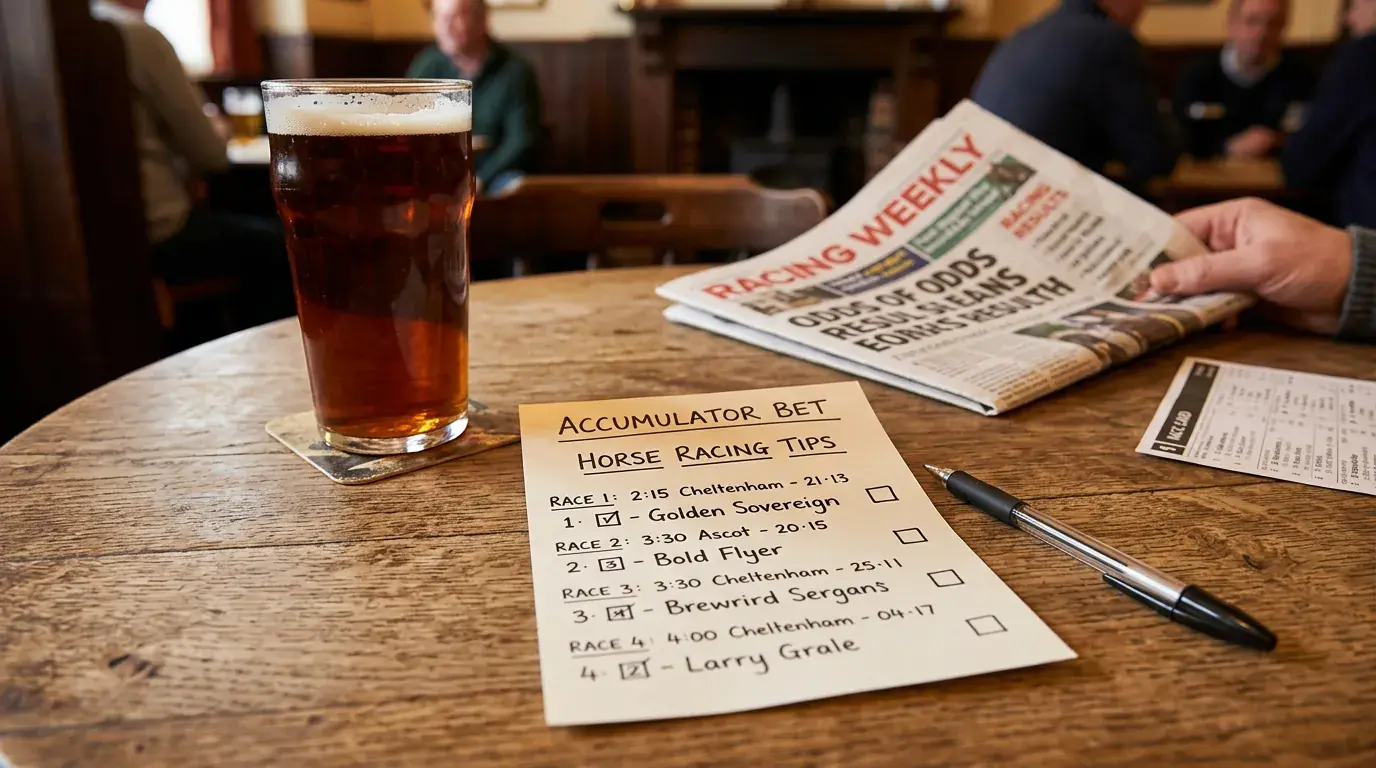
A friend of mine — sharp bettor, fifteen years of experience, profitable most seasons — once told me he had never calculated an each-way payout by hand. He ticked the E/W box on his slip, trusted the bookmaker to get the maths right, and moved on. When I showed him that the place part of his each-way bet on a 10/1 shot in a five-runner race was paying at 1/4 the odds for two places, meaning he was getting 5/2 for a place in a field where two out of five finish in the money, he stopped mid-sentence. “That is a 40% implied probability on a horse the market says has a 9% chance of winning,” he said. Then: “I have been leaving money on the table for years.”
Each-way betting accounts for 22% of all UK horse racing wagering. Only straight win bets are more popular at 36%. Yet the proportion of punters who genuinely understand the mechanics — not just the concept, but the way place terms interact with field size, race type, and implied probability to create or destroy value — is remarkably small. Most people know that each-way means you get paid if your horse wins or places. Fewer know that the place part of the bet is a separate wager with its own odds, its own implied probability, and its own edge calculation. And almost nobody treats the two halves independently, which is where the real analytical power of each-way betting lives.
This guide works through the mechanics from the ground up, then moves into the territory that matters: how to identify situations where the place component alone offers positive expected value, even when the win part does not. That is not a loophole or a trick. It is arithmetic — and it is available on every racecard, every day.
How an Each-Way Bet Splits Into Win and Place
An each-way bet is not one bet. It is two. The first half is a win bet at the full advertised odds. The second half is a place bet at a fraction of those odds, determined by the place terms set by the bookmaker. Your total stake is doubled — a ten-pound each-way bet costs twenty pounds, because ten goes on the win and ten goes on the place.
If your horse wins, both halves pay out. You collect the win bet at full odds plus the place bet at the fractional odds. If your horse finishes in a placing position but does not win, you lose the win half and collect only the place half. If it finishes outside the places, you lose both stakes.
The fraction applied to the place part is where the detail lives. Standard UK place terms are either 1/4 of the win odds or 1/5 of the win odds, depending on the race type and the number of runners. A horse at 8/1 with 1/4 place terms pays 2/1 for a place (8 divided by 4). The same horse with 1/5 place terms pays 8/5 for a place. That difference — 2/1 versus 8/5 — might look small on a single bet, but across hundreds of each-way bets it compounds into a significant impact on returns.
The critical mental shift is to stop treating the each-way bet as a single entity and start evaluating the two halves separately. Ask two distinct questions: does the win bet at these odds represent value? And does the place bet at the fractional odds represent value? If both answers are yes, the each-way bet is strong. If only the place half is positive, a place-only bet (where available) or an exchange place market bet is the sharper play. If neither half is positive, the bet should not be placed at all — regardless of how much you like the horse.
Place Terms by Field Size and Race Type
Place terms are not universal. They vary by the number of runners in a race and, in some cases, by the race type. Getting them wrong does not just reduce your return — it can turn a value bet into a losing proposition. Here is how the standard framework operates across UK racing.
In races with two to four runners, most bookmakers do not offer each-way terms at all. The bet is win only. With five to seven runners, standard terms are 1/4 the odds for two places (first and second). At eight or more runners, the standard shifts to 1/5 the odds for three places (first, second, and third). In handicap races with sixteen or more runners, terms typically extend to 1/4 the odds for four places — and this is where the each-way value landscape changes dramatically.
The sixteen-runner handicap is the each-way bettor’s natural habitat. Four places at 1/4 the odds means that roughly a quarter of the field finishes in the money, and the place fraction is more generous than the 1/5 applied to smaller fields. A 20/1 shot in a sixteen-runner handicap pays 5/1 for a place. In a ten-runner conditions race, the same 20/1 shot pays 4/1 for a place (1/5 the odds, three places). The handicap terms give you a better price and a wider net.
Festival meetings complicate the picture further. At Cheltenham, Royal Ascot, and other major festivals, some bookmakers extend place terms to five or even six places on selected races with large fields. These enhanced terms are promotional — the bookmaker absorbs the additional liability to attract volume — but they shift the each-way equation substantially. A horse at 25/1 with 1/4 odds and six places in a twenty-four-runner Cheltenham handicap is paying 25/4 (6.25/1) for a place, with a 25% chance of finishing in the money purely by field proportion. That is before you factor in any form-based assessment of the horse’s actual placing probability.
My rule of thumb: each-way bets become analytically interesting at 8/1 or longer in fields of twelve or more runners. Below 8/1, the place fraction is too small to offer standalone value in most scenarios. Below twelve runners, the number of places is too few relative to the field to create the kind of probability mismatch that each-way specialists exploit.
Handicap Place Terms and Extra-Place Offers
Every one of the 28 races at Cheltenham Festival 2025 ranked inside the top 31 by betting turnover for the entire season. That concentration is not just about prestige — it is about field sizes. Cheltenham handicaps routinely attract fields of twenty or more, triggering the extended place terms that make each-way betting most attractive.
Handicap races are designed to level the field by assigning weights based on ability. The result is that the finishing order is less predictable than in conditions races where the best horse on ratings wins more often. That unpredictability is the each-way bettor’s friend: when the race is genuinely competitive, longer-priced horses place at higher rates than their win odds imply, because the weight system gives them a legitimate chance of finishing in the frame even if they cannot win outright.
Extra-place offers amplify this dynamic. When a bookmaker extends terms from four places to five or six, the additional places are effectively free value. The odds do not change, but the probability of your horse finishing in the money increases. During Cheltenham week, I focus almost exclusively on handicaps with declared fields of eighteen or more, identify horses at 14/1 to 33/1 whose form figures suggest they can place without needing everything to fall right, and take each-way positions with bookmakers offering the most generous extra-place terms. The win half is a bonus. The place half is the bet.
Calculating Each-Way Payouts Step by Step
I am going to walk through three scenarios with real numbers, because the maths is where most each-way guides lose people — either by skipping it entirely or by burying it in notation that makes simple arithmetic look like algebra.
Scenario one: your horse wins. You have placed a ten-pound each-way bet (twenty pounds total) on a horse at 12/1 with 1/4 place terms and three places. The win half pays 12/1 on your ten-pound stake: 120 pounds profit plus your ten-pound stake returned, totalling 130 pounds. The place half pays 3/1 (12 divided by 4) on your ten-pound stake: 30 pounds profit plus your ten-pound stake returned, totalling 40 pounds. Your combined return is 170 pounds on a 20-pound outlay. Net profit: 150 pounds.
Scenario two: your horse finishes second. The win half loses — you forfeit ten pounds. The place half pays 3/1 on ten pounds: 30 pounds profit plus ten pounds stake, totalling 40 pounds. Your combined return is 40 pounds on a 20-pound outlay. Net profit: 20 pounds. Note that you have made a profit despite your horse not winning, which is the fundamental appeal of each-way betting on longer-priced selections.
Scenario three: same horse, same odds, but the race is a handicap with sixteen runners and the place terms are 1/4 the odds for four places. The place fraction is identical (1/4), but the number of places has increased from three to four. If your horse finishes fourth, your win half loses and your place half pays exactly as in scenario two: 40 pounds returned, 20 pounds net profit. The difference is not in the payout per place — it is in the probability of receiving that payout, because four places in sixteen runners gives your horse a 25% base probability of placing (before form analysis adjusts that figure), compared to 37.5% for three places in eight runners.
The conversion from fractional to decimal is useful for comparing across formats. A 12/1 horse at 1/4 place terms gives a place price of 3/1 in fractional, or 4.0 in decimal (3/1 plus 1 equals 4.0). In decimal, your return is simply your stake multiplied by the decimal place price: 10 multiplied by 4.0 equals 40 pounds. Decimal makes the maths faster, but fractional remains the standard display at UK bookmakers and on-course, so being fluent in both is practical rather than academic.
Finding Each-Way Value: When Place Odds Outweigh Win Probability
Here is where each-way betting stops being a mechanical exercise and starts being a strategic tool. The place half of your bet has its own implied probability, and when that implied probability is lower than the horse’s actual probability of placing, you have a value bet — even if the win half offers no edge at all.
Take a horse at 14/1 in a twenty-runner handicap with 1/4 odds and four places. The place price is 14/4, which is 3.5/1, or 4.5 in decimal. The implied probability of placing at 3.5/1 is 22.2% (1 divided by 4.5). Now, if you assess this horse’s form and conclude that it has a 30% chance of finishing in the first four — based on recent runs, going preference, course form, and the competitive nature of the handicap — the place half of your each-way bet is a value proposition. The market implies 22.2%, you estimate 30%. That 7.8 percentage-point gap is your edge.
Favourites win around 34% of all UK races. That means 66% of races are won by non-favourites, and the placing rate for horses in the 10/1 to 25/1 range is considerably higher than their win rate. Alan Delmonte’s observation about the early months of 2025 producing bookmaker-friendly results at Cheltenham reinforces this — when favourites underperform, longer-priced each-way selections over-deliver on their place component. The each-way bettor who has done the placement probability work captures value that the win-only bettor misses entirely.
I maintain a simple spreadsheet for each-way analysis. For every race I assess, I estimate three probabilities: the horse’s chance of winning, its chance of placing (top two, three, or four depending on terms), and the breakeven probability implied by the each-way odds. If my estimated placing probability exceeds the implied placing probability by five percentage points or more, the bet qualifies. If the gap is less than five points, I pass — the margin of error in probability estimation is wide enough that small edges are unreliable.
Each-Way Betting and In-Play Markets
More than 80% of bets at Cheltenham Festival 2024 were placed through mobile devices, and each-way volume at that meeting rose 25% on the previous year. Those two data points tell a clear story: punters are increasingly placing each-way bets on their phones, often while watching the racing live. But each-way betting and in-play markets have an awkward relationship that you need to understand before combining them.
Most fixed-odds bookmakers do not offer each-way bets in-play. Once a race starts, the each-way option disappears from the bet slip, and only win betting is available. This is a practical limitation rooted in the difficulty of recalculating place terms and place odds in real time as the race unfolds and the effective field size changes (horses that have fallen or been pulled up are no longer contenders for places).
The exchange place market is the workaround. Major exchanges operate a separate place market alongside the win market for most UK races. You can back a horse to place at exchange odds in-play, which achieves the same outcome as the place half of an each-way bet but with the flexibility to choose your own price and the transparency of seeing the full market. The trade-off is liquidity: exchange place markets carry a fraction of the volume of the win market, so getting matched at your target price during a fast-moving in-play race can be difficult.
My approach for combining each-way thinking with in-play activity is to place the each-way bet pre-race with a bookmaker — capturing the place terms and any extra-place promotion — and then manage the position in-play by laying the horse on the exchange win market if the price shortens. This hybrid approach locks in the bookmaker’s place terms (which are often more generous than exchange place market prices) while using the exchange’s in-play functionality to protect or enhance the overall position.
Three Each-Way Mistakes That Cost Punters Money
Backing short-priced horses each-way in small fields. A 3/1 shot in a six-runner race with 1/4 odds and two places gives a place price of 3/4. In decimal, that is 1.75. Your ten-pound place stake returns 17.50 for a 7.50 profit — but only if the horse finishes first or second out of six. The implied probability of placing at 1.75 is 57.1%. If you estimate this horse has a 55% chance of finishing in the top two, the place half is marginally negative. You are paying twenty pounds total for a bet where the win component might have value but the place component actively drags down your return. At short prices in small fields, a straight win bet is almost always more efficient.
Ignoring the place terms when they change. Bookmakers adjust place terms dynamically based on field sizes, and non-runners declared after you have assessed the race can change the terms. A race that had eighteen declared runners in the morning might lose three to non-runners by the afternoon, dropping the field to fifteen — and with it, the extended four-place terms revert to three places. Your each-way calculation was built on four places. At three places, the probability of placing drops and the edge may disappear. Always recheck the terms after final declarations and particularly after any non-runner is announced on the day.
Treating each-way as a consolation prize rather than a strategic position. The most common reason people bet each-way is insurance — “at least I get something back if it places.” That mentality leads to unexamined bets where the place half is negative value and the punter neither notices nor cares because the emotional comfort of partial coverage overrides the arithmetic. Each-way is not insurance. It is a two-part bet with two separate expected values. If you would not place the place part as a standalone bet, you should not be placing it as half of an each-way.
Each-Way Betting Questions Answered
Do place terms change between Flat and National Hunt racing?
The place terms themselves — 1/4 or 1/5 the odds, for two, three, or four places — are determined by field size rather than race code. A twelve-runner Flat handicap and a twelve-runner National Hunt handicap will carry the same standard terms. However, National Hunt racing tends to produce larger fields in handicap chases and hurdles, and it also generates more non-runners due to ground conditions, which can alter the effective field size and terms on the day of the race. Flat racing, particularly over sprint distances, tends to have smaller fields, making each-way terms less generous on average.
How do extra-place promotions affect each-way value at UK festivals?
Extra-place promotions extend the number of paying positions beyond standard terms — typically from three or four places to five or six in large-field races. This increases your probability of collecting on the place half without changing the place odds. The effect on value can be substantial: in a twenty-runner race, moving from four places to six increases the base probability of placing from 20% to 30% while the place price remains calculated at the original terms. During festival meetings like Cheltenham, multiple bookmakers compete on extra-place offers, so comparing terms across operators before placing each-way bets is worth the effort.
Can I place an each-way bet in-play during a horse race?
Most fixed-odds bookmakers remove the each-way option once a race goes in-play, limiting you to win-only bets. If you want to back a horse to place during a live race, the main route is the exchange place market, which operates separately from the win market. Liquidity in exchange place markets is typically thinner than in win markets, especially for smaller races, so getting matched at your preferred price can be difficult during fast-moving in-play moments.
Does a non-runner in a big field change the each-way place terms?
It can. Bookmaker place terms are linked to the number of runners at the time the market is formed. If non-runners reduce the field below a threshold — for example, from sixteen runners to fifteen in a handicap — the terms may revert from four places to three. This reduction changes the probability profile of your each-way bet and can eliminate value that existed when the terms were more generous. Always confirm the current place terms after non-runners are announced rather than relying on terms displayed when you first assessed the race.
Prepared by the Live Betting Horse Racing editorial staff.