Horse Racing Cash Out: How It Works, What Bookmakers Take, and When to Use It
 Available in US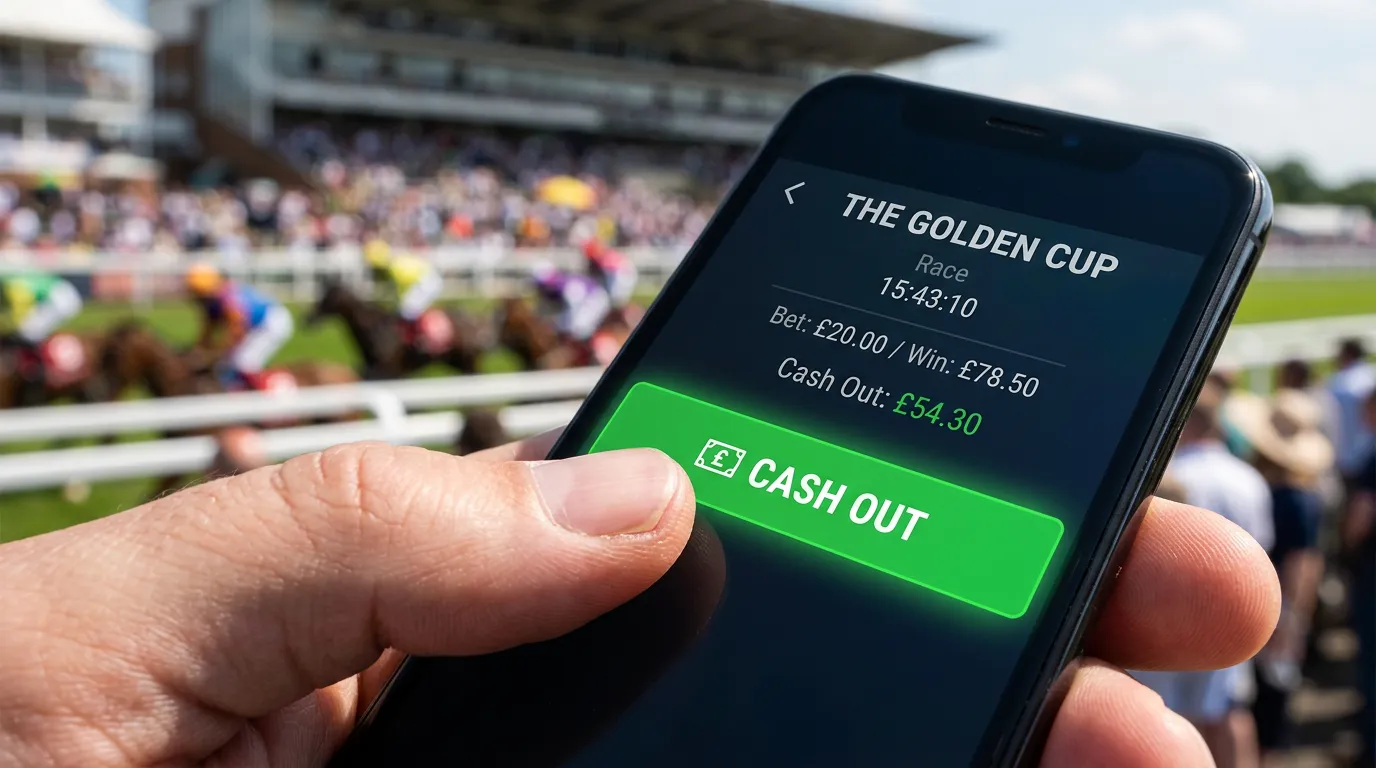
Cash Out Gives UK Punters Control — but the Bookmaker Sets the Price
I once had a 25/1 ante-post each-way bet on a horse for the Stayers’ Hurdle. By race day, the horse was trading at 8/1. The cash-out offer on my screen was 94 pounds on a five pound each-way (ten pound total) bet. I could take guaranteed profit right there, or let it ride and hope for a place at minimum. I took the cash out. The horse fell at the third-last. Best decision I made all week — but the 94 pounds I received was less than what a manual lay on the exchange would have returned. The bookmaker’s cash-out margin had quietly clipped my payout.
With 24.4 million active online gambling accounts in the UK, cash out has become one of the most widely used features in horse racing betting. It gives punters the ability to settle a bet before the result is known — locking in profit on a winning position or cutting losses on a losing one. But the price the bookmaker offers for that settlement is not neutral. Understanding how the cash-out figure is calculated, and when it’s worth taking, is the difference between smart risk management and leaving money on the table.
How Cash Out Is Calculated for Horse Racing
The cash-out price is the bookmaker’s assessment of the current value of your bet, minus a margin. It’s calculated using the current odds on your selection, the number of remaining runners, and the stage of the race (if in-play). The formula varies by operator, but the principle is consistent: the bookmaker recalculates the implied probability of your bet winning based on real-time market data and offers you a settlement that’s slightly less than the true value.
That “slightly less” is the cash-out margin, and it’s where the bookmaker profits from the feature. Estimates suggest the cash-out margin typically ranges from 3% to 8% on top of the standard overround already built into the odds. On a small-stake bet with a 50 pound cash-out value, that margin costs you roughly 1.50 to 4 pounds. On larger positions or higher cash-out values, the absolute cost scales proportionally.
The cash-out value fluctuates in real time during a race. If your horse is travelling well at the halfway point, the cash-out offer rises. If it’s fading or losing position, the offer drops. The speed of these fluctuations during in-play can be disorienting — the figure on your screen changes every second or two, and the instinct to grab a profit before it disappears creates exactly the kind of impulsive decision-making that the bookmaker’s margin exploits.
Partial and Auto Cash Out: Advanced Options
Partial cash out allows you to settle a portion of your bet while leaving the remainder active. Over 80% of bets at the 2024 Cheltenham Festival were placed via mobile, and the partial cash-out interface on mobile apps has made the feature accessible mid-race for the first time for most punters.
The strategic use of partial cash out is more nuanced than the full version. If your 10/1 selection is trading at 4/1 with two fences to jump, you could cash out 50% of your position — locking in a profit on half the bet — while leaving the other 50% to run. If the horse wins, you collect the full payout on the remaining half plus the locked-in profit. If it falls, you’ve still secured something rather than losing everything. The trade-off is that partial cashing out reduces your maximum payout, but it also reduces your maximum regret.
Auto cash out lets you set a threshold in advance: “cash out automatically if the offer reaches X pounds.” This is useful for pre-race bets when you want to lock in profit at a specific level without monitoring the screen constantly. If you’ve backed a horse at 12/1 and want to guarantee a return if the cash-out value hits 80% of potential winnings, auto cash out executes the trade on your behalf. The disadvantage is inflexibility — the auto trigger doesn’t account for how the race is unfolding, only the raw cash-out number.
When Cash Out Makes Sense — and When It Doesn’t
Cash out makes sense in three specific scenarios. First, when you’ve received new information that changes your assessment of the horse’s chance. If you backed a horse pre-race and then discover on the live stream that it’s sweating heavily, pulling hard, or clearly not travelling as expected, cashing out to limit your loss is rational risk management — not weakness.
Second, when the guaranteed return exceeds your personal utility threshold. If you’ve placed a five pound each-way bet at 25/1 and the cash-out offer is 200 pounds, taking the money is a perfectly valid choice even if the horse might win and pay more. The question isn’t whether you could win more — it’s whether the guaranteed 200 pounds matters more to you than the possibility of 260 pounds offset by the probability of zero.
Third, when your in-play analysis suggests the horse’s current market position is stronger than its actual race position. If your selection is in a prominent spot but you can see the jockey is already working hard while the horse behind is still cruising, cashing out at the current offer — which reflects the strong current position — captures value before the market corrects.
Cash out doesn’t make sense as a habitual response to anxiety. If you find yourself cashing out on every bet because you can’t bear the uncertainty, the issue isn’t the bet — it’s the staking level. Reduce your stakes to a level where you can comfortably ride out the result, and reserve cash out for the situations above where it adds genuine strategic value. For a deeper look at how manual trading on an exchange achieves the same result with a smaller margin cost, the in-play strategy guide covers the exchange alternative to bookmaker cash out.
Cash Out Questions Answered
Do all UK bookmakers offer cash out on horse racing bets?
Most major UKGC-licensed operators offer cash out on horse racing, including both pre-race and in-play cash out. However, some smaller operators do not offer the feature, and some limit it to certain bet types or markets. Cash out availability can also be temporarily suspended during periods of high volatility in a race or when the operator’s trading system cannot calculate a reliable offer.
How much margin does a bookmaker build into a horse racing cash-out price?
The cash-out margin typically ranges from 3% to 8% on top of the standard overround already embedded in the odds. This means the cash-out offer is always less than the theoretical fair value of your bet at that moment. The exact margin varies by operator, bet type, and market conditions. On exchange platforms, the equivalent operation — greening up by placing a lay bet — incurs only the standard exchange commission, which is usually lower than the bookmaker’s cash-out margin.
Created by the ”Live Betting Horse Racing” editorial team.