Horse Racing Live Streaming for Betting: Where to Watch UK Races and What the Delay Means
 Available in US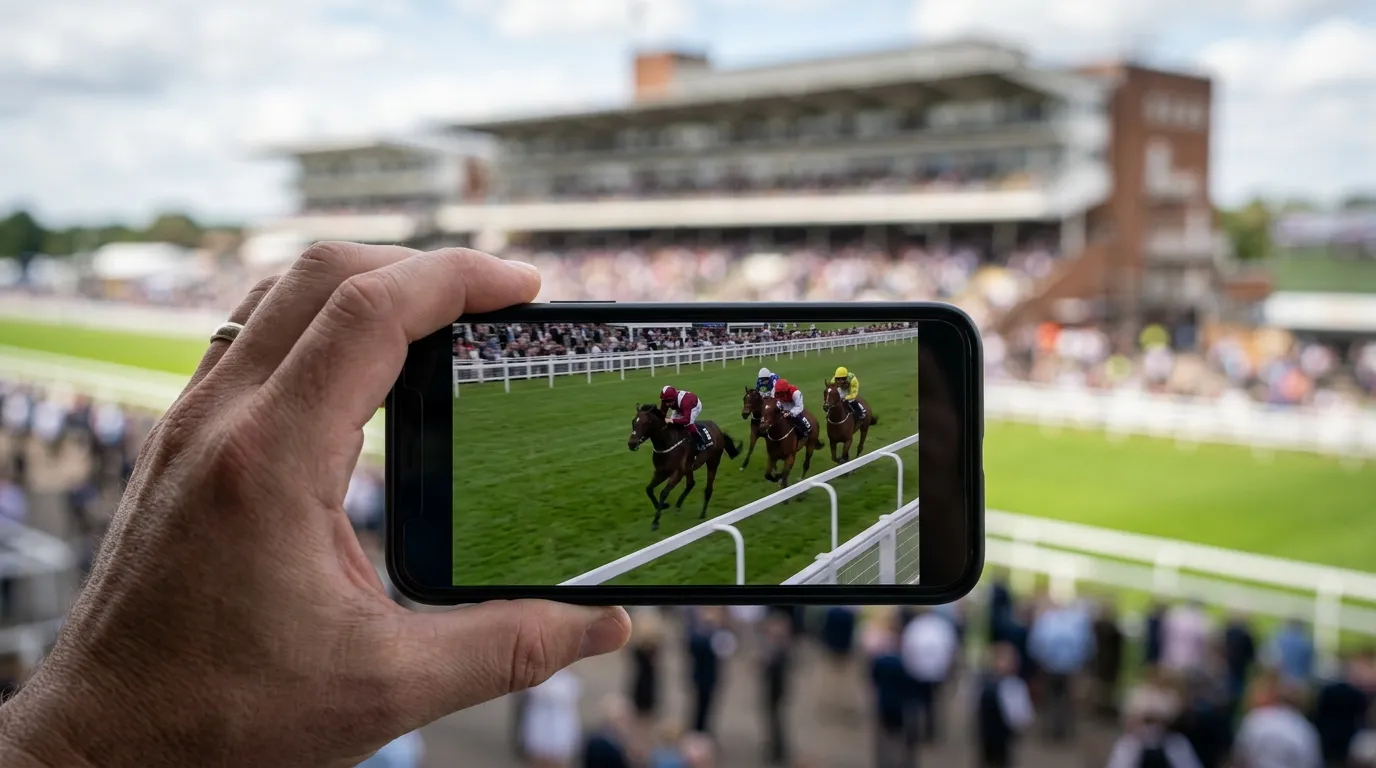
Live Streaming Underpins Every In-Play Horse Racing Bet
The first in-play horse racing bet I ever placed was essentially blind. I had no stream, no pictures, just a text commentary that updated every fifteen seconds. I backed a horse at 3/1 in-running based on a line that said “travelling well, fourth of eight.” By the time the next update loaded, the horse had fallen. Fourteen pounds gone in the gap between text refreshes. That experience taught me a lesson I haven’t forgotten: in-play betting without live pictures is guesswork with a stake attached.
Over 80% of bets placed during the 2024 Cheltenham Festival were made via mobile devices, and the vast majority of those mobile bettors were watching a live stream while they wagered. Streaming has become the infrastructure of in-play racing betting — it’s not an optional extra, it’s the mechanism through which punters assess, decide, and execute in real time.
Where to Watch UK Horse Racing Live for Free
Free live streaming of UK horse racing is available through most major UKGC-licensed betting operators, provided you hold an account and meet their eligibility criteria. Typically, that means either having a funded account — a positive balance of any amount — or having placed a bet on the race you want to watch within the last 24 hours. With 24.4 million active online gambling accounts in the UK, the streaming infrastructure reaches a massive audience.
The streams are supplied by two main providers. SIS (Satellite Information Services) covers the majority of UK and Irish racing, providing a feed that most operators use as their default. Racing TV and ITV Racing produce their own broadcasts that some operators carry as an alternative or supplement. The quality and presentation differ between feeds: SIS tends to offer a straightforward trackside camera view, while Racing TV provides commentary, analysis, and multiple camera angles.
The key consideration for a bettor isn’t picture quality — it’s which platform gives you the most seamless integration between the stream and the betting interface. If you have to switch between a streaming app and a betting app to place an in-play bet, you’re adding seconds to your execution time. The operators that embed the stream directly within the in-play betting page, with one-tap bet placement alongside the live pictures, offer a genuine functional advantage.
A few operators also stream racing through their desktop websites and dedicated apps outside the standard betting interface. These can be useful for watching races you’re not betting on, or for reviewing replays after a race to analyse how the run unfolded. Replays are underused by most punters — watching how a horse raced, where it was positioned, and how it finished gives you data that the form figures alone can’t capture.
Stream Delay and Its Impact on In-Play Betting
Every live stream you watch on a betting platform runs behind real time. The delay is deliberate, and it exists to prevent punters with access to faster information sources — on-course observers, drone feeds, or direct track-side audio — from exploiting a time advantage over the general market.
The standard delay on most UK operator streams sits between three and ten seconds behind the actual race. That number varies by platform, by race meeting, and sometimes by the time of day. Three seconds sounds trivial, but in a tight six-furlong sprint that lasts seventy seconds, three seconds represents roughly 4% of the entire race. A horse can go from third to first in that window, and the in-play odds can move by several points.
For serious in-play bettors, this delay is the single most important variable to manage. You’re not betting on what you see — you’re betting on what happened three to ten seconds ago. Every in-play price you’re offered already incorporates information that’s ahead of your stream. The market makers who set those in-play prices have access to faster data, and the price they show you reflects the real-time state of the race, not the delayed picture on your screen.
This doesn’t make in-play betting impossible or unprofitable. It means you need to adjust your approach. Rather than reacting to the exact moment on screen, you should be reading patterns: how a horse is travelling relative to its competitors, whether the pace looks sustainable, whether a jockey is starting to push earlier than expected. These pattern-level observations are less time-sensitive than the exact position at any given second, and they’re where most of the in-play value actually lives.
Getting the Best Stream Quality for Race-Day Betting
Buffering, pixelation, and dropped frames aren’t just annoying — they’re costly. A stuttering stream means you’re making in-play decisions on incomplete information, which is worse than having no stream at all because it gives you false confidence in a picture that doesn’t match reality.
Wi-Fi is more stable than mobile data for streaming, but on-course — where many serious punters place their biggest bets — 4G or 5G is the only option. Testing your connection before the first race of the day takes thirty seconds and saves you from discovering mid-race that your stream is dropping frames. I use a simple rule: if the pre-race build-up stutters, I don’t bet in-play on that race from my phone. I either switch to a different operator’s stream or sit the race out entirely.
Closing unnecessary apps and browser tabs genuinely improves stream performance on mobile devices. The processing power and bandwidth consumed by background apps can be the difference between a smooth stream and a buffered one. On race days, I close everything except the betting app and run the stream in full-screen mode to minimise the device’s workload.
Finally, know your operator’s stream quality hierarchy. Some platforms offer HD streaming on desktop but downgrade to standard definition on mobile. Others adapt automatically to your connection speed. If you’re serious about in-play betting, having accounts with two or three operators gives you fallback options when one stream is underperforming. For a broader look at in-play horse racing strategy, the quality of your information pipeline — of which the stream is the centrepiece — determines the ceiling of your in-play profitability.
Live Streaming Questions Answered
How many seconds is the typical live stream delay for UK horse racing?
Most UK betting operator streams run between three and ten seconds behind real time. The exact delay varies by platform and race meeting. Some operators publish their approximate delay; most do not. The delay is intentional and exists to prevent exploitation of faster data sources. For in-play betting purposes, assume at least a five-second lag and base your decisions on patterns of how a race is unfolding rather than reacting to specific moments on screen.
Do I need a funded betting account to access free horse racing streams?
Most UKGC-licensed operators require either a funded account or a recently placed bet to access their live racing streams. The minimum balance requirement is typically nominal — sometimes as little as one penny in your account. Some operators require a bet to have been placed within the last 24 hours. Specific eligibility criteria vary by operator, so check the streaming terms before relying on a particular platform for race-day coverage.
Created by the ”Live Betting Horse Racing” editorial team.