Horse Racing Odds Explained: How UK Prices Are Formed and What They Tell You
 Available in US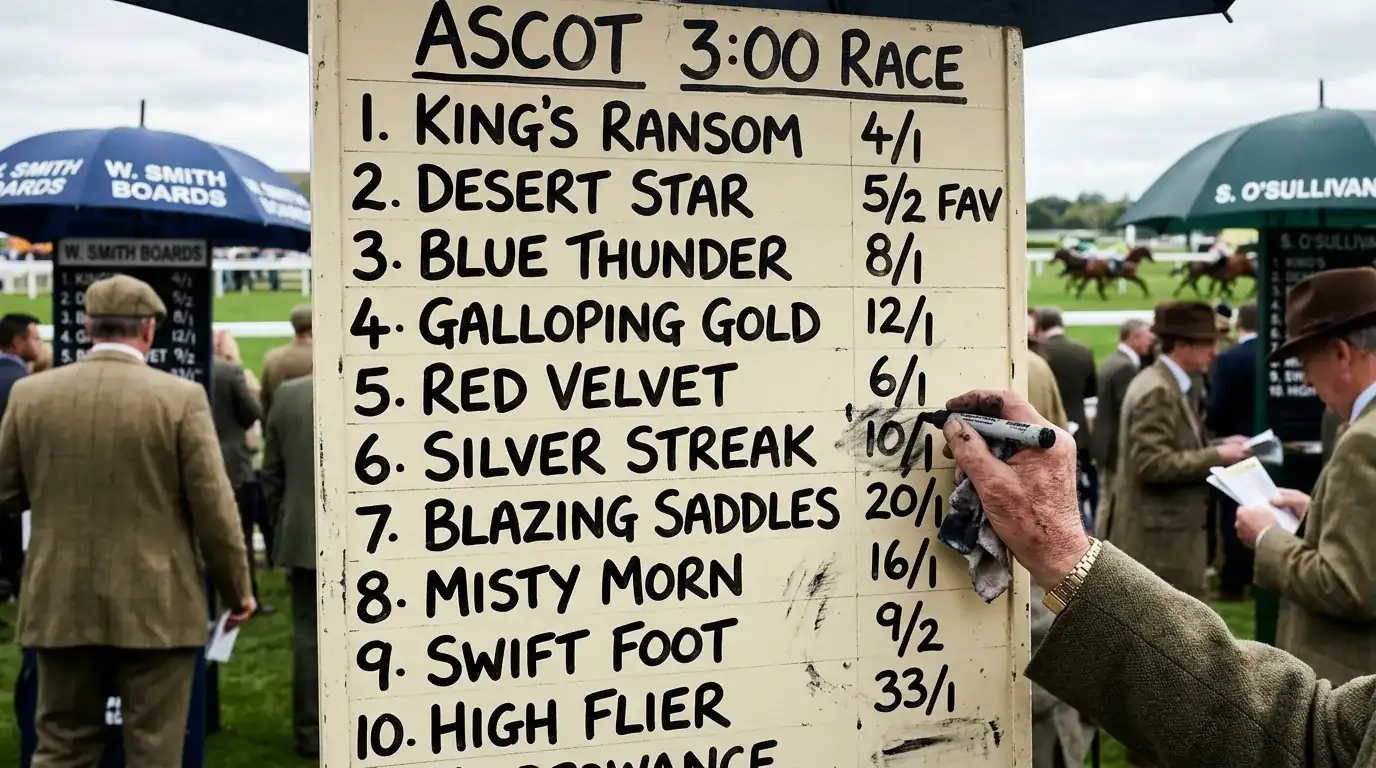
Table of Contents
- UK Horse Racing Odds Carry More Information Than Most Punters Extract
- Fractional, Decimal, and American: Reading the Three Formats
- Implied Probability and the Overround
- How Bookmakers Build a Horse Racing Market
- Starting Price vs Early Price: When to Lock In
- How Odds Shift In-Play and What Drives the Move
- Spotting Value: Overlays, Drifts, and Market Signals
- Odds and Pricing Questions Answered
UK Horse Racing Odds Carry More Information Than Most Punters Extract
I spent my first two years betting on horse racing without understanding how odds were made. I could read them — 5/1 meant five pounds back for every one staked, simple enough. But I had no idea why a horse was 5/1 and not 4/1 or 7/1, who decided, or what forces moved the price between morning and post time. I was reading the menu without knowing what was in the kitchen.
That ignorance cost me. Not dramatically — I was not haemorrhaging money — but I was making decisions without the information embedded in the prices themselves. Remote horse racing betting generated 766.7 million pounds in gross gambling yield for UK-licensed operators in the year to March 2025, and every penny of that yield flows through the pricing mechanism. Odds are not just a payout ratio. They are a compressed signal containing the market’s collective assessment of probability, adjusted for the bookmaker’s margin, shaped by money flow, and distorted by sentiment. Learning to decode that signal is arguably the most important skill a horse racing punter can develop.
This guide does what none of the top-ranking pages in the UK betting space actually do: it explains not just the format of odds, but the machinery behind them. How a bookmaker’s trader builds a market from scratch, why prices move, what the Starting Price really represents, and how to identify the gap between the market’s implied probability and your own assessment. That gap — when it exists in your favour — is value. And value is the only sustainable reason to bet.
Fractional, Decimal, and American: Reading the Three Formats
Three formats exist for expressing the same underlying relationship between stake and return. None is superior — they are different languages for the same concept. But fluency in at least two is essential for any UK punter, because you will encounter fractional odds on-course and on most UK bookmaker sites, decimal on exchanges and European platforms, and American if you ever stray into US-facing content.
Fractional odds are the UK standard. A price of 7/2 means you receive seven pounds for every two pounds staked, plus your stake back. A ten-pound bet at 7/2 returns forty-five pounds: thirty-five profit plus ten stake. The fraction is a ratio of profit to stake, nothing more. Odds-on prices work identically: 4/6 means four pounds profit for every six staked. A ten-pound bet at 4/6 returns sixteen pounds sixty-seven — six pounds sixty-seven profit plus the ten-pound stake.
Decimal odds express the total return per unit staked. A price of 4.5 means that a one-pound bet returns four pounds fifty, including the stake. To convert fractional to decimal, divide the first number by the second and add one: 7/2 becomes 3.5 plus 1, which is 4.5. Decimal is cleaner for calculations and comparisons, which is why exchanges and most analytical tools use it by default. When I build models or run numbers, I work exclusively in decimal.
American odds use a baseline of one hundred. A positive number (say +350) tells you the profit on a hundred-unit stake: +350 means 350 pounds profit on 100 staked. A negative number (say -150) tells you how much you must stake to profit one hundred: -150 means you stake 150 to win 100. Most UK punters will never need American odds unless they are reading US racing content or using a platform that defaults to that format. The conversion from fractional to American is: multiply the fractional odds by 100 if the price is evens or above (7/2 becomes +350), or divide 100 by the fractional odds and negate if the price is odds-on (1/2 becomes -200).
The format does not change the probability or the payout. It changes the speed at which you can calculate and compare. My advice: set your primary bookmaker accounts to decimal, learn to read fractional on sight because it is unavoidable in UK racing media, and ignore American unless you specifically need it.
Implied Probability and the Overround
Every set of odds implies a probability. A horse at 3.0 in decimal implies a 33.3% chance of winning (1 divided by 3.0). A horse at 5.0 implies 20%. A horse at 1.5 implies 66.7%. This conversion is the bridge between odds and the real world — it translates a payout ratio into a statement about how likely the market thinks an outcome is.
The formula is the same regardless of format. In decimal: implied probability equals 1 divided by the decimal price. In fractional: implied probability equals the denominator divided by the sum of numerator and denominator. A 7/2 shot has an implied probability of 2 divided by (7 plus 2), which is 22.2%.
Now here is the part that matters. Add up the implied probabilities of every runner in a race and you will get a number higher than 100%. In a competitive eight-runner race, the sum might be 118%. That excess — the 18% above 100% — is the overround. It represents the bookmaker’s built-in margin. Every horse in the market is priced slightly shorter than its true probability would warrant, and that collective shortening is how the bookmaker guarantees a profit regardless of the outcome.
The size of the overround varies. Big Saturday races with heavy competition between bookmakers might carry overrounds of 108% to 112%. A Tuesday afternoon selling race at a minor track might carry 125% to 135%. Exchange markets, where odds are set by participants rather than a bookmaker’s trading desk, routinely operate at 101% to 103%. The practical implication: the higher the overround, the worse the value for the punter. If you are comparing prices across platforms, looking at the total overround across the field gives you a quick measure of which market is offering the fairest prices.
I check the overround of every race I assess. Not because I expect to find a market with no margin — that does not exist in practice — but because an overround above 125% tells me the bookmaker is pricing defensively, likely in a thin market with high uncertainty. Those are races where the gap between the implied probability and the true probability is widest, which means both the best and worst value bets tend to cluster in high-overround markets. Knowing where you are on that spectrum shapes how aggressively you should bet.
How Bookmakers Build a Horse Racing Market
Most punters assume odds appear fully formed, like a product on a shelf. The reality is more like watching a sculpture take shape. A bookmaker’s trading team builds a horse racing market through a process that starts hours or even days before the race and does not stop until the off — and the forces shaping that market are a mix of data analysis, commercial pressure, and raw money flow.
The process begins with the compiler — the person (or increasingly, the algorithm) who creates the initial set of prices for a race. The compiler analyses form, conditions, trainer and jockey data, and creates what the industry calls a tissue price: the initial probability assessment before any money has been taken. The tissue is the skeleton. Everything that follows is the market reacting to it.
Once the tissue is set and the market opens, prices start moving in response to betting activity. William Hill alone accounts for 37.83% of pay-per-click advertising clicks in UK sports betting, and the volume of customers that kind of traffic drives into a market creates substantial price pressure from the moment the market goes live. Large bets on a horse shorten its price and force a compensating drift in the prices of its rivals. The bookmaker’s trading desk monitors this flow in real time, adjusting prices to manage their liability — ensuring they are not overexposed on any single runner.
Brant Dunshea, acting as chief executive of the British Horseracing Authority, expressed concern that regulatory changes could make it more expensive for operators to run horse racing markets, which would in turn reduce promotional activity and narrow the range of prices available to punters. That concern highlights the commercial dimension of odds formation: the prices you see are not just probability estimates. They are also a function of the bookmaker’s cost base, competitive positioning, and strategic priorities. A bookmaker running a Best Odds Guaranteed promotion absorbs additional risk on every horse whose Starting Price exceeds the early price, and that cost is ultimately reflected in slightly wider overrounds across the card.
The Tissue Price: Where It All Starts
The tissue price is the market before the market. It is the bookmaker’s internal assessment of each horse’s chance, compiled from form data, speed figures, trainer patterns, going preferences, and any intelligence the trading desk has gathered. The tissue does not appear on any public-facing platform. It exists as an internal document that guides the opening prices.
Why does the tissue matter to you as a punter? Because the opening prices set the anchor around which all subsequent trading revolves. If the tissue puts Horse A at 4/1 and the opening price is 4/1, and you believe — based on your own analysis — that Horse A should be 3/1, you have identified a potential value bet before the market has even begun to move. Conversely, if the opening price is 2/1 on a horse you rate at 4/1, the bookmaker has already priced in information or money that disagrees with your assessment.
Experienced punters develop a sense for when opening prices diverge from expected tissue levels. A horse whose morning price is significantly shorter than form analysis would suggest is often one that has attracted insider money or stable confidence before the public market has engaged. A horse whose opening price is longer than expected might be facing a concern — a fitness doubt, a dislike of the ground, an intended running plan that the market does not favour — that has not been publicly reported. The tissue, even though you never see it directly, casts a shadow over every price you encounter.
Starting Price vs Early Price: When to Lock In
The Starting Price — SP — is the official price at the moment the race begins, determined by on-course bookmakers through a process overseen by the Starting Price Regulatory Commission. It is the benchmark against which all other prices are compared, and it serves as the settlement price for any bet taken at SP rather than a fixed early price.
Early prices are the odds offered by bookmakers in the morning or afternoon, sometimes hours before the race. These prices are fixed at the moment you place your bet — if you take 8/1 at 10am and the SP drifts to 12/1 by post time, your bet still pays at 8/1 (unless Best Odds Guaranteed applies, in which case you receive the higher SP). The question of whether to take an early price or wait for the SP is one of the most common decisions in UK horse racing betting, and the answer depends on your assessment of how the market will move.
Favourites win about 34% of UK races. That figure stays remarkably consistent year to year, and it means that the market — as expressed by the SP — is the single best predictor of race outcomes available. But the SP is a snapshot of the final pre-race market, and the path from early price to SP often contains exploitable gaps. A horse whose early morning price is 10/1 might drift to 14/1 by mid-afternoon as other runners attract money, then shorten back to 10/1 approaching the off as late support arrives. If you took the 10/1 in the morning, you captured fair value. If you waited and caught the 14/1 at 2pm, you captured over-value. If you waited for the SP and it returned 10/1, you are back to square one.
My decision framework: take the early price when I have strong conviction and the current price matches or exceeds my assessment. Wait when the market is still forming, particularly in races with large fields where the order of betting activity is unpredictable. And use SP only when I have no strong view on direction or when the race is so competitive that the price could move significantly in either direction and I want the flexibility of not being locked in.
How Odds Shift In-Play and What Drives the Move
Pre-race odds move in response to money. In-play odds move in response to events — and money chasing those events. The distinction matters because the drivers of price movement are fundamentally different once the tape goes up, and the strategies for reading those movements require a different lens.
Win bets make up 36% of all UK horse racing wagering. Each-way accounts for another 22%, with forecast and tricast bets at 17% and multiples at 10%. In-play, almost all activity concentrates in the win market because place markets, exotic bets, and multiples are either unavailable or illiquid once the race is running. That concentration means in-play prices on the win market are a purer signal of perceived probability than pre-race prices, which are spread across multiple bet types and diluted by promotional distortions.
Three categories of information drive in-play price shifts. Positional data — where is the horse in the field, how is it travelling, what is its proximity to the leaders — accounts for the gradual oscillations that occur between dramatic events. Incidents — a fall, a stumble, a jockey’s whip being dropped — cause sharp, instantaneous movements. And momentum psychology — the tendency for market participants to follow a moving price rather than assess the underlying change in probability — amplifies both. A horse that moves from fifth to second between two fences might see its in-play price halve, even if the move was the result of other horses weakening rather than its own acceleration. The price reflects the visual impression of progress, not always the reality.
Reading in-play odds well means separating signal from noise. A horse whose price shortens because it has moved smoothly into contention under a confident ride is sending a genuine signal. A horse whose price shortens because the camera angle made it look closer to the leaders than it actually is — a common artefact of head-on shots — is noise. Developing the ability to distinguish between the two comes from watching hundreds of races with the exchange market open alongside the stream, tracking how prices respond to specific visual cues, and building a mental library of patterns.
Spotting Value: Overlays, Drifts, and Market Signals
Value is the single word that separates professional punters from recreational ones. Not in the sense that professionals always win — they do not — but in the sense that every bet a professional places is grounded in a specific assertion: “The true probability of this outcome is higher than the market implies.” If that assertion is correct often enough, and the stakes are managed sensibly, profit follows over a sufficient sample.
An overlay is a horse whose price is longer than your assessment suggests it should be. If you rate a horse at a 25% chance of winning and the market offers 5.0 (implying 20%), the horse is an overlay. The four-percentage-point gap is your edge. A 10/1 shot you rate at 12% is an overlay. A 2/1 favourite you rate at 30% is not — the market implies 33.3%, which is more generous than your own assessment.
Drifts are one of the most reliable signals for identifying overlays. A horse that drifts from 4/1 to 6/1 in the last hour before a race has not become worse at running. Its form is unchanged, its fitness is unchanged, its jockey is unchanged. What has changed is the weight of money in the market — other runners have attracted support, and this horse has not. If your pre-market analysis concluded that 4/1 was fair value, then 6/1 represents a clear overlay. The drift has handed you two extra points of value without any change in the underlying probability.
Market signals work the other way too. A horse that shortens sharply from 8/1 to 4/1 in the final thirty minutes is attracting informed money. That does not mean it will win — informed money is wrong often enough — but it does mean the market is pricing in information you may not have. When a horse you rated at 8/1 fair value is suddenly 4/1, it is no longer a value bet by your assessment. The discipline is to walk away, even if you “like” the horse, because the price no longer supports a positive expected-value bet.
I keep a record of every overlay I identify, whether I bet or not. Over a season, that record reveals the accuracy of my probability assessments in aggregate. If horses I rate at 25% are winning 28% of the time, my model is underpricing them slightly — a useful calibration. If they are winning 18% of the time, I am overconfident in that probability range and need to adjust. The record is the feedback loop that turns betting — including each-way positions — from an opinion-based activity into a data-driven one.
Odds and Pricing Questions Answered
Why do horse racing odds differ between bookmakers for the same race?
Each bookmaker sets prices based on their own trading position, liability exposure, and commercial strategy. A bookmaker who has already taken heavy bets on one horse will shorten that horse’s price to discourage further backing and lengthen the prices of rivals to attract balancing money. Promotional activity such as Best Odds Guaranteed, enhanced odds offers, and price boosts also create temporary differences. The result is that at any given moment, the price for the same horse can vary by several points across different operators — which is why checking multiple bookmakers before placing a bet is standard practice for serious punters.
How is the Starting Price calculated for UK horse racing?
The Starting Price is determined by the Starting Price Regulatory Commission based on the odds available from on-course bookmakers at the moment the race begins. Independent assessors record the prices displayed by on-course bookmakers at the off, and the SP is calculated as a representative price from that snapshot. It is not an average of online bookmaker prices and it is not set by any single operator. The SP serves as the settlement price for bets taken at SP and as the benchmark for Best Odds Guaranteed promotions.
What does an overround above 130% tell me about a horse racing market?
An overround above 130% indicates that the bookmaker has built a wide margin into the prices, meaning the implied probabilities across all runners sum to well above 100%. This typically occurs in low-profile races with thin markets, small fields with one heavy favourite, or markets with high uncertainty where the bookmaker is pricing defensively. For punters, a high overround means worse value on every selection in the race. If you encounter a market with an overround above 130%, the prices are structurally poor and you should either seek better prices on an exchange or consider whether the race is worth betting on at all.
Published by the Live Betting Horse Racing team.