Horse Racing Betting Exchanges in the UK: How Lay Betting and Trading Actually Work
 Available in US
Table of Contents
- Exchanges Reshaped Horse Racing Betting — Most Punters Still Don’t Use Them
- The Mechanics of Back and Lay on an Exchange
- Commission Structures: What You Actually Pay
- Exchange vs Fixed-Odds Bookmaker: A Direct Comparison
- Lay Betting Explained: Risks, Liability, and When It Makes Sense
- In-Running Trading on the Exchange
- Which Punters Benefit Most from Exchanges
- Exchange Limitations: Liquidity Gaps, Latency, and Market Depth
- Exchange Betting Questions Answered
Exchanges Reshaped Horse Racing Betting — Most Punters Still Don’t Use Them
The first time I placed a lay bet on a horse racing exchange, I genuinely thought I had broken something. I had selected a horse, typed in a price, and the screen told me my liability was three hundred and forty pounds on a fifty-pound trade. I stared at the number, closed the browser, and did not go back for a week. That was 2017. By 2019, exchanges accounted for the majority of my horse racing activity. The learning curve is steep, but the terrain on the other side is worth the climb.
Remote horse racing betting generated 766.7 million pounds in gross gambling yield for licensed UK operators in the year ending March 2025. The overwhelming majority of that figure flows through traditional fixed-odds bookmakers. Exchanges capture a fraction of the total market, yet they offer something no bookmaker can: the ability to bet against a horse winning. That single mechanical difference — laying — transforms horse racing from a one-directional game into a two-way market. And for punters who learn to navigate it, the implications are profound.
This piece breaks down how exchanges work from the ground up: how bets get matched, what commission really costs, how lay betting exposes you to risk that feels unfamiliar at first, and why certain types of punters find exchanges indispensable while others never touch them. If you have been curious about exchange trading but put off by the jargon or the apparent complexity, the mechanics are simpler than they look once the fog of terminology clears.
The Mechanics of Back and Lay on an Exchange
Think of an exchange as a marketplace, not a shop. At a bookmaker, you walk up to a counter and accept the price on offer. At an exchange, you walk into a room full of other punters and negotiate directly. The exchange itself does not take a position — it simply provides the platform, matches buyers with sellers, and takes a small commission on the winner’s profit.
Every exchange market has two sides: back and lay. Backing is identical to placing a bet with a bookmaker — you are staking money on a horse to win, and if it does, you collect at the agreed price. Laying is the opposite: you are offering odds to someone else, effectively acting as the bookmaker for that particular bet. If the horse loses, you keep the backer’s stake. If it wins, you pay out at the agreed price.
The exchange displays these two sides as columns. The back column shows the best available price at which you can back each horse, along with the amount of money waiting to be matched at that price. The lay column shows the best available price at which you can lay each horse, with the corresponding available money. The gap between the best back price and the best lay price is the spread — and in a liquid horse racing market on a Saturday afternoon, that spread can be as tight as one tick.
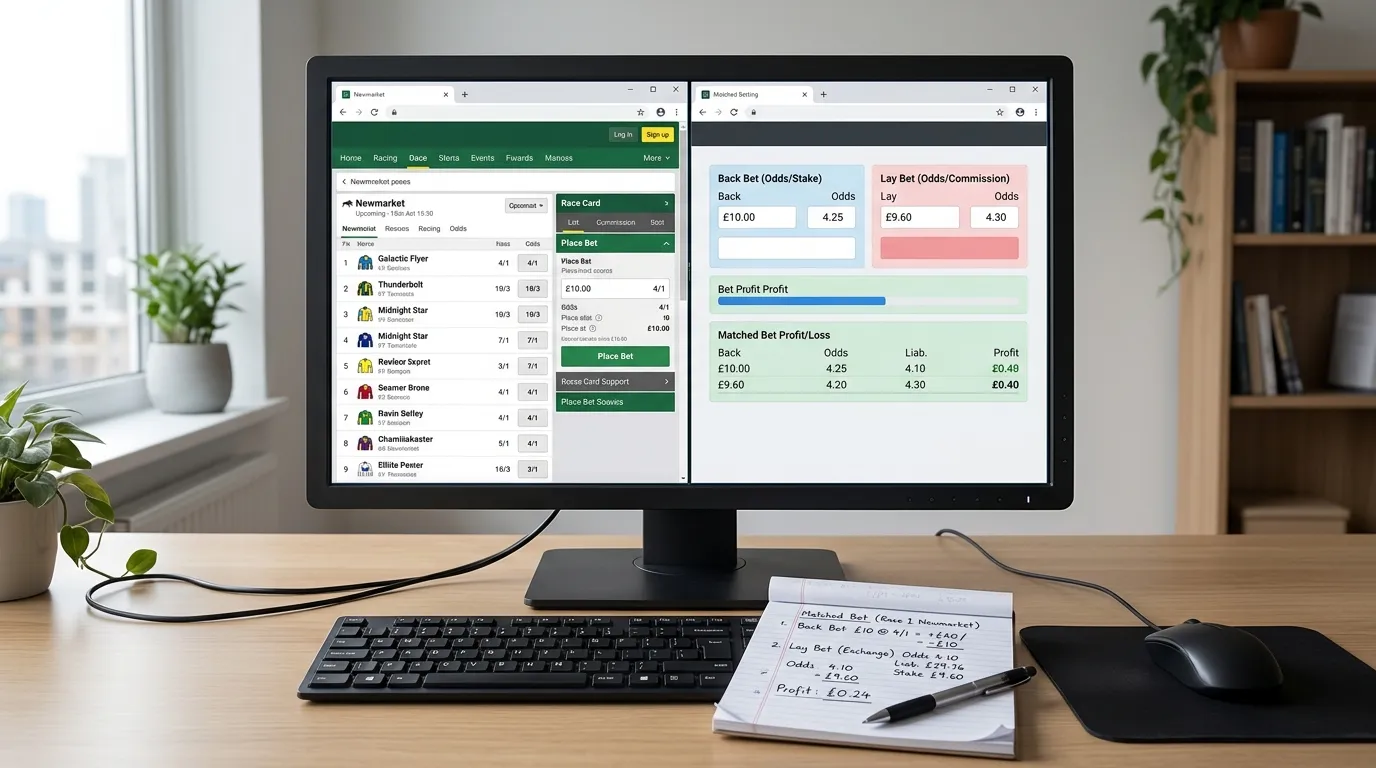
A worked example clarifies the flow. Horse A is available to back at 5.0 and to lay at 5.2 in a 3pm race at Ascot. You want to back Horse A at 5.0 for twenty pounds. You submit the order. If someone on the other side of the market has already offered to lay at 5.0 for at least twenty pounds, your bet is matched instantly. If not, your order sits in the queue at 5.0 until someone matches it — or until you cancel. If Horse A wins, you receive eighty pounds profit (5.0 multiplied by twenty, minus your stake). The exchange deducts commission on that eighty pounds. If Horse A loses, you lose your twenty-pound stake, and no commission applies because you made no profit.
This peer-to-peer structure means there is no bookmaker margin baked into the price. The odds are set by the collective activity of thousands of participants. In practice, exchange prices on horse racing are almost always better than fixed-odds prices for the same horse — sometimes fractionally, sometimes substantially, especially in less liquid markets where bookmaker overrounds are wider.
How Bets Get Matched: Liquidity and the Order Book
Liquidity is the lifeblood of an exchange market. Without it, your orders sit unmatched and your strategy remains theoretical. Understanding how the order book works — and where liquidity concentrates — is the difference between executing trades cleanly and watching opportunities evaporate while your money sits in a queue.
The order book is a stack of unmatched bets at various prices. On the back side, orders are ranked from highest price (most attractive to backers) downward. On the lay side, orders are ranked from lowest price (most attractive to layers) upward. When a new order arrives that matches an existing order on the opposite side, the exchange pairs them instantly. If no match exists, the new order joins the queue at its specified price.
In horse racing, liquidity follows a predictable pattern. It is thinnest in the morning when early prices are posted, builds through the afternoon as the race approaches, peaks in the final five minutes before the off, and then shifts into the in-play market where it behaves differently — arriving in bursts triggered by race events rather than accumulating steadily. A Group 1 race at Royal Ascot might have six or seven figures of matched volume by post time. A Monday evening handicap at Wolverhampton might struggle to match five figures total.
The practical lesson is to time your orders around liquidity peaks. If you want to back a horse at 6.0 for a meaningful stake, submitting the order at 10am when only a few hundred pounds have been matched at that price is unlikely to fill quickly. Submitting at 2:50pm for a 3:00pm race gives you access to the deepest pool of opposing money. For in-play orders, the first thirty seconds after the off typically see the highest volume as pre-race positions are adjusted and new in-play participants enter.
Commission Structures: What You Actually Pay
Nothing in exchange trading annoys me more than the moment I check my net profit and see the commission line item. It is small enough to feel insignificant on any single trade and large enough to reshape your annual profit and loss when you add it up across a thousand trades.
Exchange commission applies only to net winning positions on a market. If you back a horse and it wins, you pay commission on your profit. If you back a horse and it loses, you pay nothing. The base rate varies by platform and by your activity level — new accounts typically start at 5% of net profit, and high-volume traders can negotiate or earn reductions down to 2% or lower through loyalty programmes.
Flutter Entertainment, which operates the dominant UK horse racing exchange, reported revenue of 15.91 billion dollars across its global business in 2025 — a 17% increase on the prior year. Exchange commission is a meaningful contributor to that figure. For you as a punter, the commission rate directly affects the viability of tight-margin strategies. A scalper working one-tick trades at 5% commission needs a significantly higher strike rate to break even than the same scalper at 2%. Over a season of trading, the difference between 5% and 2% commission can be the difference between a modest profit and a genuine income stream.
One detail that catches newcomers: commission is calculated on your net profit per market, not per bet. If you back a horse at 6.0 and then lay it at 4.0 to lock in a profit, the commission applies to the net outcome after both legs settle — not to each leg individually. This matters because it means hedging (greening up) does not double your commission cost. The exchange treats the entire market as a single settlement event.
Exchange vs Fixed-Odds Bookmaker: A Direct Comparison
I keep accounts with both exchanges and fixed-odds bookmakers. Not out of indecision — out of practicality. Each model has structural advantages that the other cannot replicate, and knowing when to use which is a genuine edge in itself.
The fixed-odds bookmaker sets a price, offers it to you, and profits from the overround — the built-in margin across all runners that ensures the total implied probability exceeds 100%. In the remote betting sector, horse racing sits as the second-largest sport behind football, generating a substantial share of total GGY. That margin funds the bookmaker’s operations, marketing, and profit. For you, it means the price you receive is structurally worse than the true probability of the outcome.
The exchange eliminates the overround. Prices are set by participants, not by a house. In a competitive exchange market, the overround across all runners can drop below 102% — compared to 115% or higher at a traditional bookmaker on the same race. That difference translates directly into better prices for backers. Over a hundred bets at identical stakes, a punter consistently taking exchange prices will show a higher return than the same punter taking bookmaker prices, all else being equal.
Where bookmakers hold the advantage is in promotions and convenience. Best Odds Guaranteed, free bet offers, enhanced place terms, and accumulator bonuses are tools that bookmakers use to attract and retain customers. Exchanges offer none of these. A bookmaker also guarantees your bet is matched the moment you place it — no waiting in a queue, no worrying about liquidity. For casual punters who bet occasionally and value simplicity, bookmakers are the logical choice.
Nevin Truesdale, who served as Chief Executive of the Jockey Club, framed the regulatory side of the debate sharply when he argued that the Gambling Commission’s approach risked reducing the market to small-stakes activity only. That concern resonates with exchange users because exchanges thrive on volume and staking flexibility — two things that a heavily restricted market constrains. For punters who trade actively, who want to lay as well as back, and who are willing to manage their own positions, exchanges offer a structural advantage that compounds over time. For everyone else, bookmakers remain the simpler path.
The bet type breakdown across UK horse racing tells its own story: win bets account for 36% of the market, each-way for 22%, singles for 15%, multiples for 10%, and forecast or tricast bets for 17%. Exchanges dominate the win-bet segment because that is where the pricing advantage is clearest. Each-way, accumulators, and exotic bets remain overwhelmingly bookmaker territory because exchanges either do not support them natively or offer them with inferior liquidity.
Lay Betting Explained: Risks, Liability, and When It Makes Sense
Laying a horse at 5.0 for ten pounds means you are offering someone a bet at odds of 5.0. If the horse loses, you pocket their ten-pound stake. If it wins, you pay them forty pounds — the odds minus one, multiplied by their stake. That forty pounds is your liability, and it is the number that should command your attention, not the stake.
Liability is the concept that trips up nearly every exchange newcomer. When you back a horse, your maximum loss is your stake — a fixed, known amount. When you lay a horse, your maximum loss is your liability, which scales with the odds. Lay a horse at 2.0 for ten pounds and your liability is ten pounds. Lay the same horse at 10.0 for ten pounds and your liability is ninety pounds. Same stake, nine times the risk. This asymmetry is why lay betting demands more careful position sizing than backing.
When does laying make sense? Three scenarios come up repeatedly in my trading. First, opposing a false favourite — a horse whose price is shorter than the form justifies, often because of name recognition, a high-profile jockey booking, or media hype. Laying that horse at a price I consider too short gives me a structural edge if my assessment is correct. Second, as the closing leg of a back-to-lay trade, where the lay locks in profit on a position I opened earlier at a higher price. Third, in-play after a horse has made a mistake that the market has not yet fully priced in — a bad jump, a loss of position, a jockey switching to the whip earlier than expected.
The risk management rule I follow for lay bets is simple: never let your liability on a single lay exceed 3% of your trading bank. At a thousand-pound bank, that caps my liability at thirty pounds per lay. It means I can comfortably lay horses at prices up to 4.0 at ten-pound stakes, but if I want to lay a 10.0 shot, my stake drops to three pounds to keep the liability within bounds. This constraint feels limiting at first, but it is the discipline that prevents one losing lay from destabilising the entire bank.
In-Running Trading on the Exchange
The moment a race goes in-play, the exchange market transforms. Pre-race, prices move gradually as information filters through and money accumulates. In-play, prices swing violently in response to real-time events — a stumble at a fence, a burst of acceleration, a wall of horses blocking a run on the rail. The skill set required shifts from analytical patience to pattern recognition under time pressure.
In-running trading on an exchange means opening and closing positions while the race is live. You might back a horse at 6.0 when it is travelling well in mid-division and lay it at 3.5 when it moves into contention two fences later. Or you might lay a front-runner at 2.0 early in the race and back it at 4.0 when a challenger closes the gap. Each of these is a complete trade — entry, exit, profit or loss determined by the price movement between the two.
The exchange’s in-play market operates with a slight delay — typically around one second — between an event occurring on the course and the market reopening for trading. This delay exists to prevent participants with faster information (course-side observers, low-latency video feeds) from exploiting those with standard streams. In practice, the delay levels the playing field enough for manual traders to compete, but it does mean that you cannot react to events in true real time. Your in-play strategy needs to account for the fact that by the time you see something and submit an order, the market has already absorbed at least part of the information.
For newcomers to in-running exchange trading, I recommend starting with observation only. Watch five or six races on the exchange without placing a trade. Track how prices move, how quickly the market reacts to incidents, and where the price stabilises between events. That observation period builds the intuition you need before risking real money — and it costs nothing except time.
Which Punters Benefit Most from Exchanges
Exchanges are not for everyone, and pretending otherwise does nobody any favours. The punters who benefit most from exchange trading share a few characteristics that are worth examining honestly before you commit time and money to learning the platform.
Value-focused backers gain the most immediate advantage. If your approach to horse racing betting involves identifying overpriced runners and backing them systematically, the exchange’s tighter overround means you are capturing more of the edge you have identified. Over a season of a thousand bets, the cumulative difference between exchange prices and bookmaker prices can add hundreds of pounds to your bottom line without changing anything about your selection process.
Traders — punters who want to profit from price movements rather than race outcomes — have no real alternative to exchanges. Bookmakers do not offer lay betting, and while cash-out functions allow partial position management, they do not provide the flexibility or the pricing transparency that exchange trading requires. If your goal is to trade horse racing markets the way a financial trader works equity or currency markets, the exchange is your venue.
High-staking punters find exchanges valuable because exchanges do not restrict winning accounts. A bookmaker who identifies a consistently profitable customer will limit their stakes, restrict their access to promotions, or close their account entirely. Exchanges, by contrast, welcome volume regardless of profitability because their revenue comes from commission on all activity, not from customer losses. For punters whose bookmaker accounts have been limited — a common experience for anyone who wins regularly — exchanges provide unrestricted market access.
Exchange Limitations: Liquidity Gaps, Latency, and Market Depth
I have sung the praises of exchanges for several hundred words. Now for the cold water. Exchanges have real structural limitations that affect your experience daily, and ignoring them leads to frustration and avoidable losses.
Liquidity gaps are the most persistent issue. Major UK races — Cheltenham, Royal Ascot, the Grand National — attract deep exchange markets where you can get matched at competitive prices even for large stakes. Tuesday afternoon racing at Sedgefield does not. In thin markets, the spread between back and lay can be three, four, or five ticks wide, which erodes the pricing advantage that makes exchanges attractive in the first place. If the best back price is 5.0 and the best lay is 5.6, you are effectively paying a spread wider than some bookmaker margins. I avoid trading on the exchange in markets where the spread exceeds two ticks, because the execution cost neutralises the structural benefit.
Latency is the second limitation. Exchange markets process orders sequentially, and during fast-moving in-play moments — a horse falling, a sudden acceleration — the volume of orders can exceed the market’s capacity to match them instantly. Your order might queue behind hundreds of others, and by the time it reaches the front, the price has moved past your target. This is particularly acute in the final furlong of a race, where prices move in fractions of a second and manual traders are competing against automated systems.
Market depth is the third consideration. The headline price on the exchange — the best available back or lay — might only have fifty or a hundred pounds behind it. If you want to trade at three hundred pounds, you will be matched across multiple price levels, and your average execution price will be worse than the headline figure. Checking the depth of the order book before submitting a trade is a habit that takes thirty seconds and saves real money.
Finally, exchanges do not offer each-way betting, accumulators, or forecast and tricast bets in the way bookmakers do. You can construct synthetic each-way positions by backing in the win market and the place market separately, but the liquidity in exchange place markets is often a fraction of the win market. For punters whose primary activity involves these bet types, bookmakers remain the practical choice.
Exchange Betting Questions Answered
How much commission do UK horse racing exchanges charge per winning bet?
The standard starting rate is 5% of net profit on a market, though high-volume traders can reduce this to 2% or lower through loyalty programmes or negotiated rates. Commission only applies to winning positions — if you lose a bet, no commission is charged. The rate is calculated on your net profit per market after all bets in that market are settled, so hedging or greening up does not trigger double commission.
Can I use a betting exchange for in-play horse racing without trading software?
Yes. The exchange’s web interface and mobile app provide all the functionality needed for manual in-play trading. Third-party trading software adds features like one-click betting, automated stop-losses, and ladder interfaces that display the full order book, which can improve execution speed. However, many profitable in-play traders work entirely through the standard platform. Software becomes more valuable as your trade frequency increases and the margins you target become tighter.
Why do exchange odds for horse racing differ from bookmaker prices?
Bookmaker prices include an overround — a built-in margin that ensures the total implied probability across all runners exceeds 100%, typically by 10% to 20%. Exchange prices are set by other punters competing against each other, which drives the overround down to 101% to 103% in liquid markets. The result is that exchange back prices are usually higher than bookmaker prices for the same horse, meaning a better potential return for the backer.
What happens if my lay bet on a horse racing exchange is unmatched?
An unmatched lay bet sits in the order book at your specified price until either another participant backs at that price or you cancel the order. If the race starts and your bet is still unmatched, the exchange will either cancel it automatically (if you have selected that option) or carry it into the in-play market where it may be matched at your price during the race. You are not charged anything for unmatched bets — only matched, winning positions attract commission.
Written by the editors at Live Betting Horse Racing.